Licensing a remittance business in the UAE
How the Central Bank of the UAE licenses money transfer: the Exchange Business Regulation, the app-only Category IV licence, capital and guarantees, AML duties and partners.
Sending money abroad for customers is a licensed financial activity in the UAE. The Central Bank of the UAE (CBUAE) licenses it under the Exchange Business Regulation (Circular No. 7/2025, in force since 26 June 2025), which replaced the 2014 rules for exchange houses. A business that only sends money through an app applies for its Category IV licence.
This guide is general information, not legal advice: the details depend on your services and your market, so confirm them with a lawyer and the regulator before you apply. UAE rules change often, so each rule below carries the version and date its regulator shows.
What remittance is in law
The CBUAE law, Federal Decree-Law No. (6) of 2025 (in force since 16 September 2025), lists currency exchange and money transfer among licensed financial activities (Article 61(1)(e)). Article 62 applies that to any medium or technology, including platforms and decentralised applications that facilitate remittances. Firms had one year from entry into force to bring themselves into line, a period the CBUAE board may extend (Article 184).
The Exchange Business Regulation defines remittances broadly: accepting money from a payer to transmit it, or receiving money for a payee, domestic or cross-border, with or without a payment account. The Retail Payment Services and Card Schemes Regulation (Circular No. 15/2021, in force since 6 June 2021) excludes payment transactions involving remittances, so it is not the licence for a remittance business. VARA and the Capital Market Authority, formerly the SCA, license virtual asset activities, not fiat money transfer.
Who regulates it, and where
Onshore, the CBUAE. An exchange house must be incorporated in the UAE outside the financial free zones (Article 6). DIFC and ADGM, financial free zones with their own regulators, have their own regimes:
DIFC: the DFSA licenses money transmission as Providing Money Services (GEN Rule 2.6.1, GEN module VER72/07-26). Its Conduct of Business module (VER51/07-26) bans cash and requires dirham transactions to settle through an institution licensed by the CBUAE to take deposits (Rule 13.2).
ADGM: the FSRA licenses Money Remittance as Providing Money Services, paragraph 52 of Schedule 1 to the Financial Services and Markets Regulations 2015 (consolidated version 29, in force from 21 May 2026).
The Category IV licence
Category IV covers remittances through digital channels, such as mobile and web apps, with no physical outlets. It allows no cash in or out, and currency conversion only as part of a remittance (Article 3). Categories I to III cover currency exchange, adding remittances in Categories I and II and salary processing in Category I.
Legal form and owners. A limited liability company. Non-UAE nationals may own up to 40% of an exchange house, but for Category IV the CBUAE may allow full foreign ownership (Articles 6 and 7).
Capital. Paid-up capital of AED 25,000,000, injected after in-principle approval and before the final licence (Article 8). The CBUAE may require more.
Bank guarantee. AED 25,000,000 in favour of the CBUAE, on top of the capital, which may not fund it. Once trading, it must equal the higher of that minimum or 5% of six months' average monthly inward and outward remittances, measured at 30 June and 31 December. If no bank will issue it, an equal cash deposit at the CBUAE takes its place (Article 9).
People. The chairman, most of the board, all mandatory positions and heads of functions must be UAE nationals or residents, based in the UAE (Article 13).
Customer money. Customers' funds go into designated remittance intermediate accounts at CBUAE-licensed banks daily, or by the end of the next business day, and serve only to settle with foreign correspondents. An external auditor checks those accounts and reports monthly to the board (Article 24.11).
Customers. Notify them at each stage of a transfer, give official receipts, and show rates and fees on your website and app (Article 24).
Technology. Your systems must handle AML compliance, end-to-end processing, accounting, reconciliation and regulatory reporting, and none may be hidden from the CBUAE (Article 12).
Outsourcing and correspondents. No function may be outsourced without a letter of no objection, and licensed activities never (Article 15). Each correspondent or payout relationship, and any arrangement with an instant money transfer provider, needs a letter of no objection too (Articles 3.14 and 24.22).
The Regulation works with the CBUAE's Standards for exchange business (Notice No. 35/2018, 1 March 2018, as amended), which are binding and add the detail, including financial ratios.
AML and sanctions duties
Federal Decree-Law No. (10) of 2025 is the AML law, in force since 14 October 2025. Its implementing regulation, Cabinet Resolution No. (134) of 2025 (in force since 14 December 2025), sets the duties for money transfer:
verify the originator for international transfers of AED 3,500 or more, and send names, account numbers or a unique reference, and the originator's identifying details with every transfer, below that amount too (Article 28);
do not execute a transfer that lacks this information;
keep an up-to-date list of any agents and bring them into your AML programme (Article 27);
where you handle both ends of a transfer, use both sides' information to decide on a suspicious transaction report (Article 31).
Reports go to the UAE Financial Intelligence Unit through goAML, and new licensees register on it straight after licensing (CBUAE guidance, in force since 7 June 2021). For sanctions, register with the Executive Office for list updates, freeze without delay, which Cabinet Decision No. 74 of 2020 defines as within 24 hours of a listing, and notify the CBUAE and the Executive Office immediately (CBUAE guidance, in force since 4 July 2021). The CBUAE's guidance for exchange houses (in force since 11 November 2021) covers the sector's risks.
The steps
Meet the CBUAE's Licensing Department before applying (Article 4).
Apply with the form, supporting documents and undertakings to comply.
Receive in-principle approval, then inject the capital and put the guarantee in place. The CBUAE's licensing page gives you one year from the approval letter to meet its conditions.
Receive the licence and start business before the deadline the CBUAE sets, or the licence lapses (Article 24.18). An annual declaration is due by 31 January each year.
The CBUAE does not publish processing times for these licences.
Partnering with a licensed exchange house
Launching on an exchange house's licence is not a white label. An exchange house may not rent out its licence, be managed by another firm or outsource its licensed activities (Articles 24.7, 24.8 and 15). The CBUAE law also lists arranging, promoting and marketing licensed activities as licensed activities in their own right (Article 61(1)(h)). A partnership therefore has to leave the exchange house as the provider in substance, and fronting its licence can mean you need your own. Agree the structure with the CBUAE before you build on it.
Two other paths exist. The CBUAE may let existing payment service or stored value licensees offer app-based remittances, provided they meet this Regulation, including its capital and guarantee (Article 3.7). And a remitter licensed abroad can register with the CBUAE as an instant money transfer provider and work through a UAE exchange house (Article 3.14).
Common mistakes
Applying under the payments regulation. It excludes remittances.
Incorporating in a financial free zone. An exchange house must be onshore.
Budgeting the capital but not the guarantee. Both are AED 25,000,000, and the guarantee grows with volume.
Mixing customer funds with operating money. Remittance funds have their own accounts.
Dropping data on small transfers. Information travels below AED 3,500 too.
Moving value on stablecoins. Onshore, the CBUAE's Payment Token Services Regulation (Circular No. 2/2024, in force since 31 August 2024) limits which tokens may be used, and for what.
What this means for your platform
Several of these duties are product features: rates and fees on display, status updates at every stage, receipts, and full originator data on every transfer.
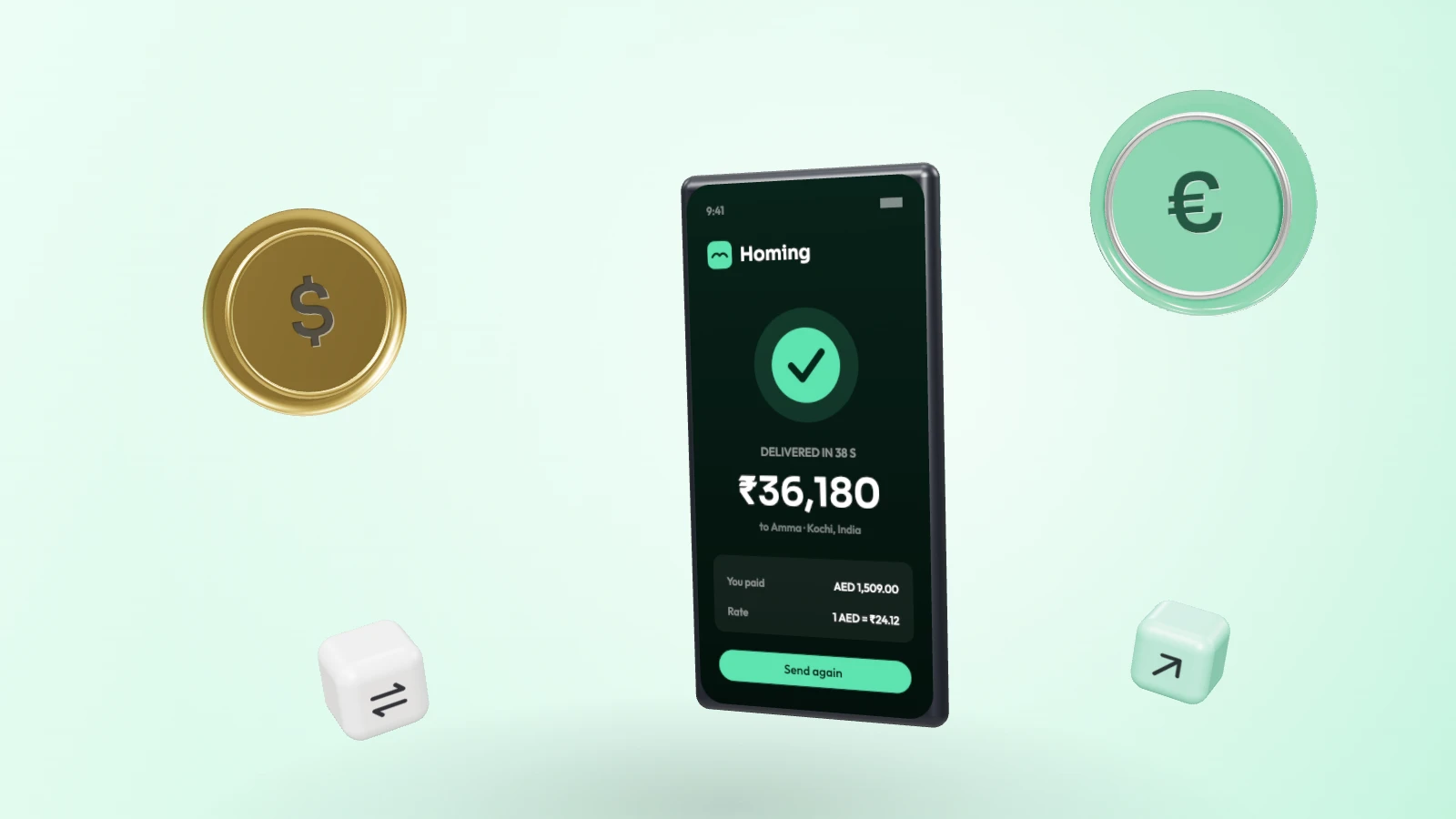
Our white-label remittance app shows the fee, the rate and the amount that arrives before the customer pays, tracks each transfer from paid to delivered with a timestamp on every step, and ends with a receipt showing the rate, the fee and a reference. It screens senders and recipients against sanctions lists, monitors transactions and keeps the records your MLRO needs. Payout partners are connectors, and we connect the correspondents your licence approves. We configure the platform to match your legal set-up.
Sources
Checked on 6 October 2026.
CBUAE Rulebook, Exchange Business Regulation, Circular No. 7/2025: https://rulebook.centralbank.ae/en/rulebook/exchange-business-regulation
CBUAE Rulebook, Federal Decree-Law No. (6) of 2025: https://rulebook.centralbank.ae/en/rulebook/federal-decree-law-no-6-2025-regarding-central-bank-regulation-financial-institutions-and
CBUAE Rulebook, Retail Payment Services and Card Schemes Regulation, Circular No. 15/2021: https://rulebook.centralbank.ae/en/rulebook/retail-payment-services-and-card-schemes-regulation
CBUAE Rulebook, Payment Token Services Regulation, Circular No. 2/2024: https://rulebook.centralbank.ae/en/rulebook/payment-token-services-regulation
CBUAE, Licensing: https://www.centralbank.ae/en/licensing/
VARA, Licence Applications: https://www.vara.ae/en/licenses-and-register/licence-applications/
CBUAE Rulebook, Federal Decree-Law No. (10) of 2025: https://rulebook.centralbank.ae/en/rulebook/federal-decree-law-no-10-2025-regarding-anti-money-laundering-and-combating-financing
CBUAE Rulebook, Cabinet Resolution No. (134) of 2025: https://rulebook.centralbank.ae/en/rulebook/cabinet-resolution-no-134-2025-regarding-executive-regulations-federal-decree-law-no-10
CBUAE Rulebook, guidance on suspicious transaction reporting: https://rulebook.centralbank.ae/en/rulebook/guidance-licensed-financial-institutions-suspicious-transaction-reporting
CBUAE Rulebook, guidance on targeted financial sanctions: https://rulebook.centralbank.ae/en/rulebook/guidance-licensed-financial-institutions-implementation-targeted-financial-sanctions
CBUAE Rulebook, guidance for licensed exchange houses: https://rulebook.centralbank.ae/en/rulebook/guidance-licensed-exchange-houses
DFSA Rulebook, GEN 2.6 Providing Money Services: https://dfsaen.thomsonreuters.com/rulebook/gen-26-providing-money-services
DFSA Rulebook, Conduct of Business module, VER51/07-26: https://dfsaen.thomsonreuters.com/rulebook/conduct-business-module-cob-ver5107-26
ADGM, Financial Services and Markets Regulations 2015: https://en.adgm.thomsonreuters.com/rulebook/financial-services-and-markets-regulations-2015-0