How a broker adds crypto buy and sell without running an order book
In broker mode the operator sells crypto from its own inventory at a firm quote, shows the price and fee before Accept, books the trade on a ledger and hedges the position at a liquidity venue.
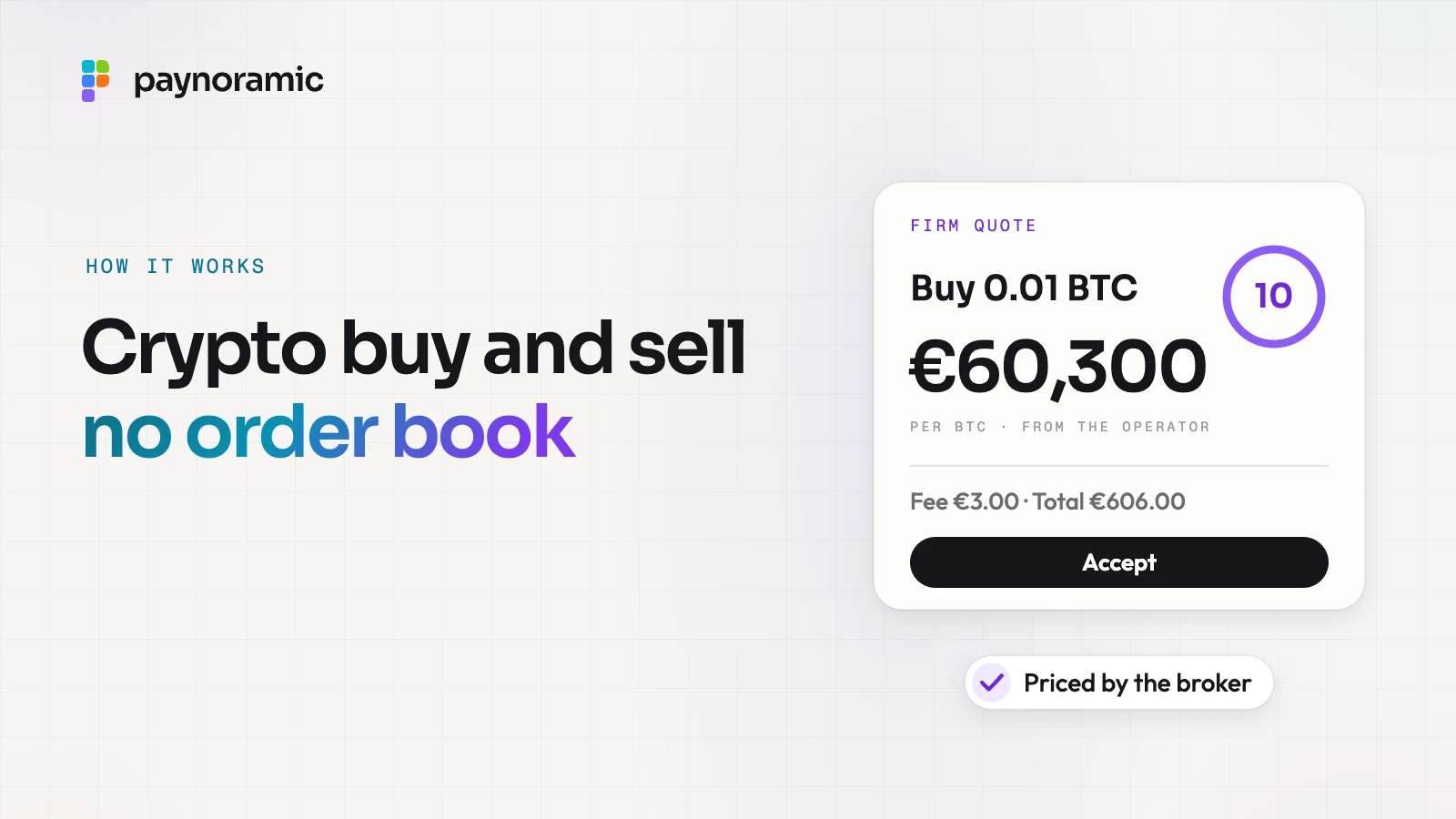
A broker, neobank or fintech can let its customers buy and sell crypto without running an order book by becoming the other side of every trade. The customer asks for a price, the operator answers with a firm quote from its own inventory, valid for a few seconds, and shows the spread and fee before the customer accepts. The trade is booked on the operator's ledger, and the operator hedges the position it has taken at a liquidity venue, outside the app.
Two ways to sell crypto: an order book or a broker
On an exchange, customers trade with each other. Their orders rest in an order book and a matching engine pairs a buyer with a seller, as the guide to what happens when you press Buy explains. The price is whatever the book offers at that moment, and a thin book means a poor price.
In broker mode there is no book. The operator quotes a price, and if the customer accepts, the operator sells from its own holdings or buys into them. The customer always gets a price, in any size the operator is willing to quote, and the operator carries the market risk instead.
Order book | Broker mode | |
|---|---|---|
Who the customer trades with | Another customer | The operator |
Where the price comes from | Resting orders in the book | The live market price plus the operator's spread |
What the customer sees first | The book, or an estimate | A firm price, the fee and the total |
What the operator needs | Enough buyers and sellers, often market makers | Inventory, a hedging venue and risk limits |
Who carries the price risk | The customers | The operator, until it hedges |
Many operators run both: an order book for active traders, and a simple Buy and Sell screen for everyone else that is priced by the broker.
The quote: a firm price for a few seconds
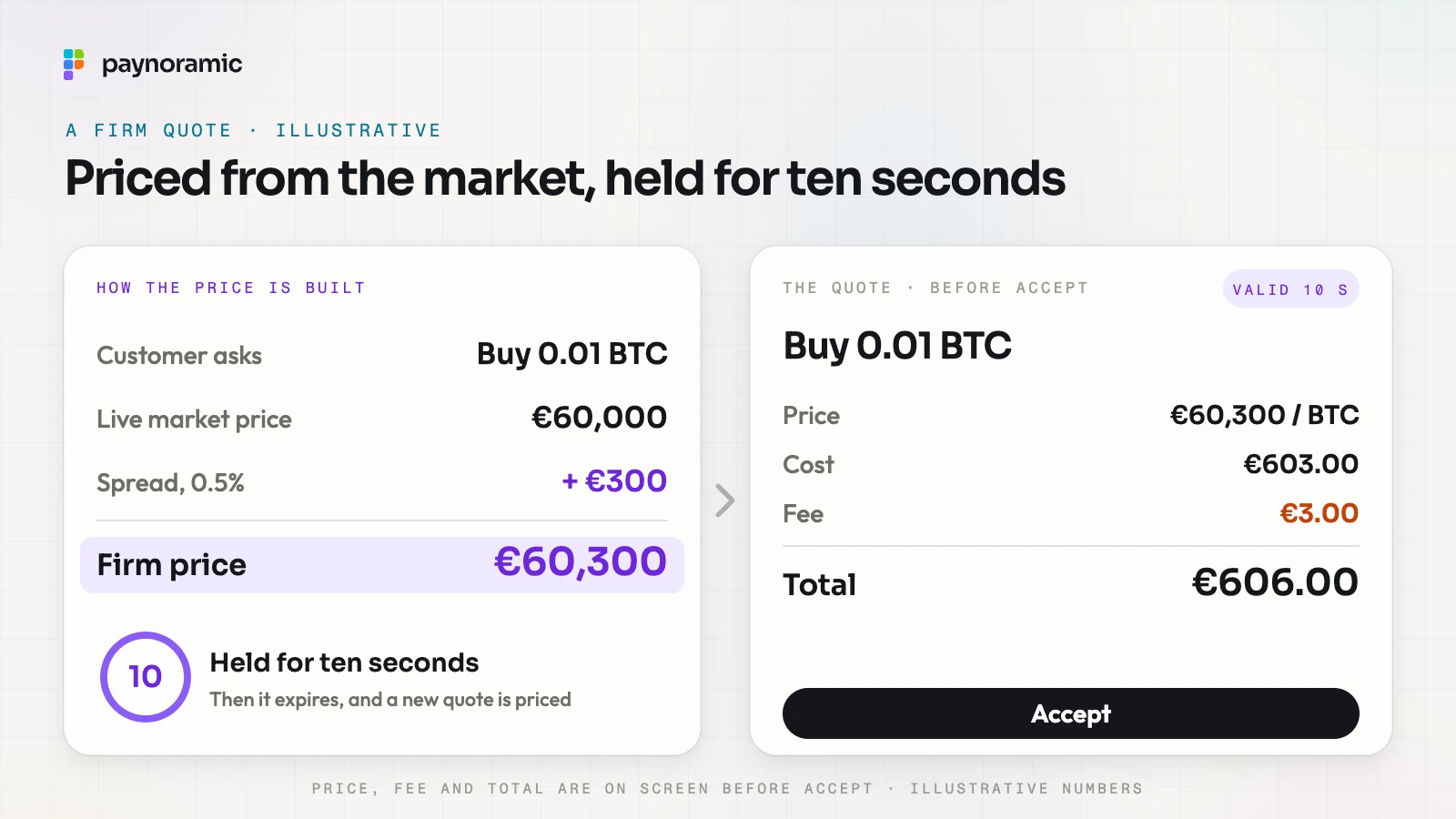
A quote is a short-lived promise. The example in this guide, with illustrative numbers, follows one customer who wants 0.01 bitcoin.
The request. The customer picks an asset, a side and an amount: buy 0.01 BTC, paid in euros.
The reference price. The pricing service takes the live market price from the venues it watches. Here, 60,000 euros per bitcoin.
The spread. The operator adds its margin on the side the customer trades: 0.5%, or 300 euros, so the buy price is 60,300. A seller would be offered less than 60,000. The bid-ask spread can widen with size, with the asset, or when markets are fast.
The firm price. The customer is shown 60,300, held for ten seconds. Inside that window, the price will not change.
The breakdown. Before Accept is pressed, the screen shows the price, the cost of 603.00 euros, a fee of 3.00 euros and the total of 606.00 euros.
When the window runs out, the quote expires and the app asks for a new one at the new market price. A short window keeps the operator's exposure small; a longer one is kinder to a customer reading the screen. In a retail app the window is usually a few seconds, with a fresh quote shown when it runs out.
Accepting, and booking the trade
Accepting inside the window fixes the trade at the quoted price, whatever the market does next. The system checks that the quote is still valid and that the customer has 606 euros available, then records the trade once, with the quote's own identifier, so a double tap cannot buy twice.
The trade is then booked on a double-entry ledger: every movement is recorded twice, once leaving one account and once arriving in another, so each currency sums to zero.
Euros. The customer's account goes down by 606.00. The operator's account goes up by 603.00 and the fee revenue account by 3.00.
Bitcoin. The operator's inventory goes down by 0.01. The customer's account goes up by 0.01.
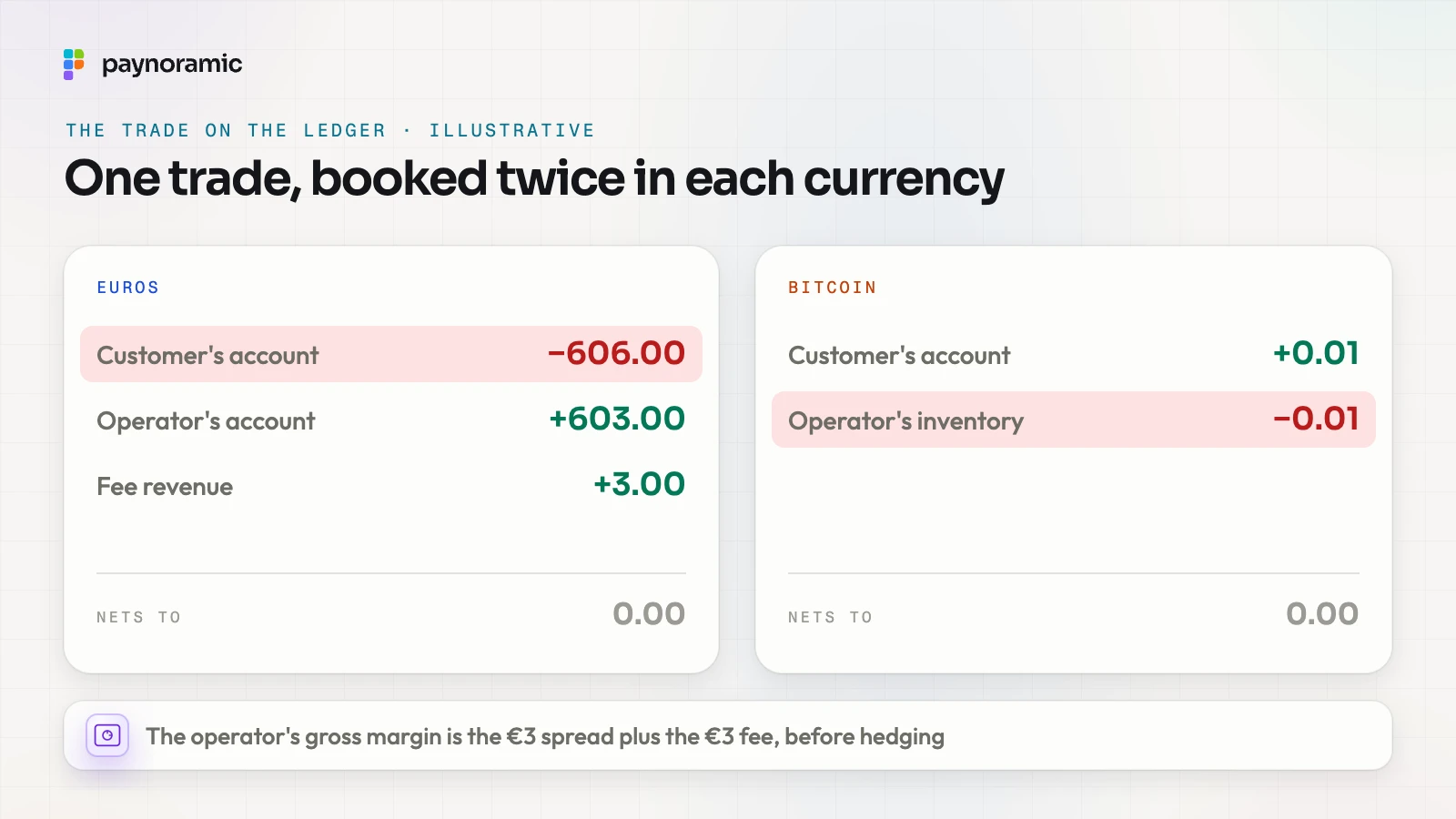
The operator's gross margin on this trade is the 3 euro spread plus the 3 euro fee. Whether it keeps the spread depends on what happens next. You can see this in Marengo, our exchange: its broker mode gives customers firm quotes from the operator's own inventory, and its double-entry ledger is reconciled.
Hedging: keeping the inventory near its target
Every sale draws down the operator's bitcoin, and every purchase from a customer adds to it. Left alone, the inventory drifts, and the operator ends up holding a large position it never chose.
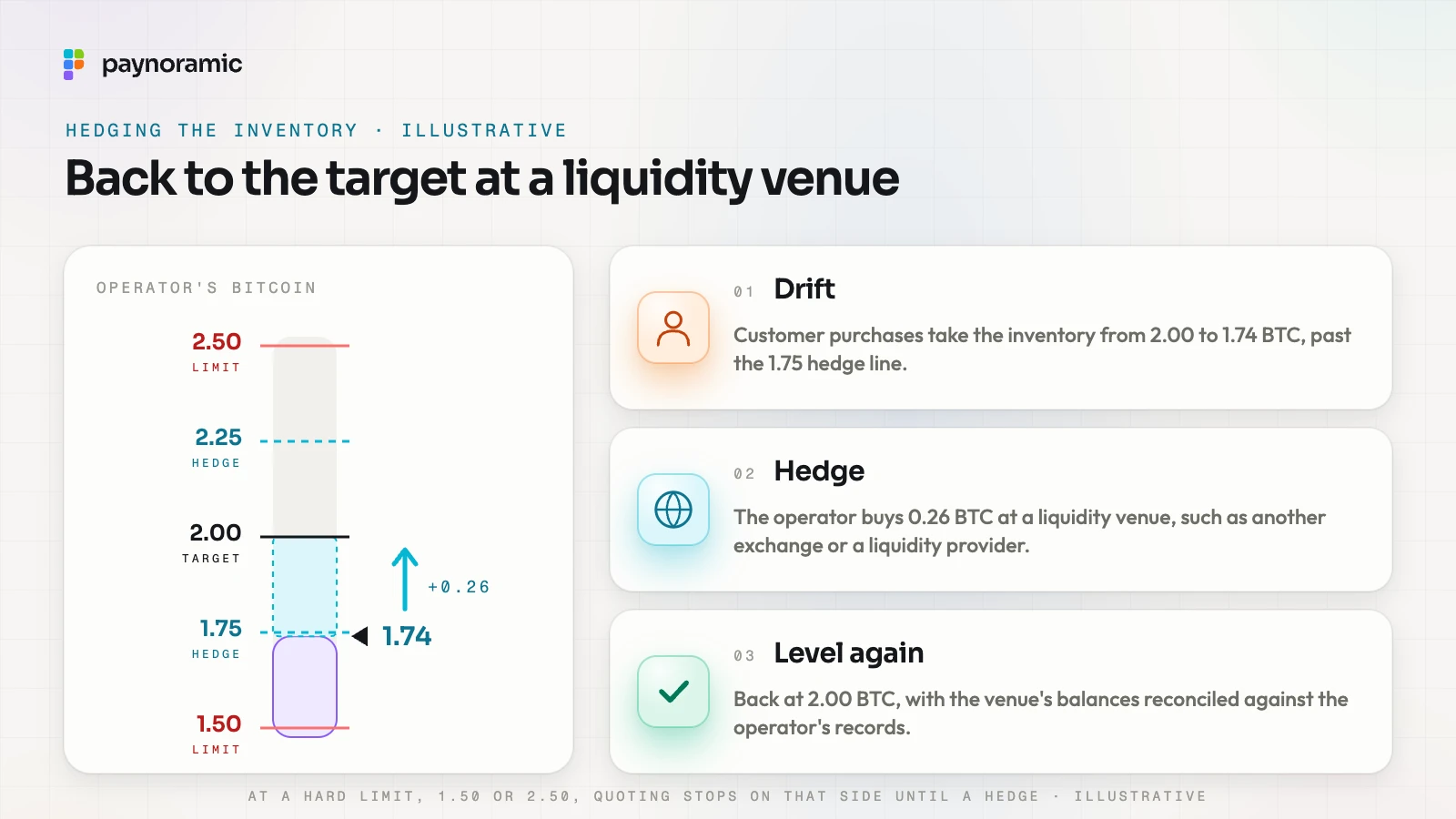
So the operator sets a target and limits around it. In the example, the target is 2.00 BTC, a hedge is placed whenever the inventory leaves the band from 1.75 to 2.25, and quoting stops on one side at the hard limits of 1.50 and 2.50.
Drift. A run of customer purchases takes the inventory from 2.00 down to 1.74 BTC, past the lower hedge line.
Hedge. The operator buys 0.26 BTC at a liquidity venue: another exchange, or a liquidity provider that quotes to firms.
Level again. The inventory is back at 2.00, and the venue's balances are reconciled against the operator's own records.
Hedging in batches nets customer buys against customer sells, so the operator trades less often and pays fewer venue fees. Some brokers hedge every trade at once instead, which removes most of the market risk but adds a venue fee and a little delay to every quote.
When the market moves
The risk sits between the sale and the hedge. In the example the customer bought at 60,300 when the market was at 60,000. If the market rises to 60,500 before the operator buys back, replacing 0.01 BTC costs 605 euros against the 603 received, and the 3 euro spread has become a 2 euro loss. The fee is still earned, but on a fast day the spread is not.
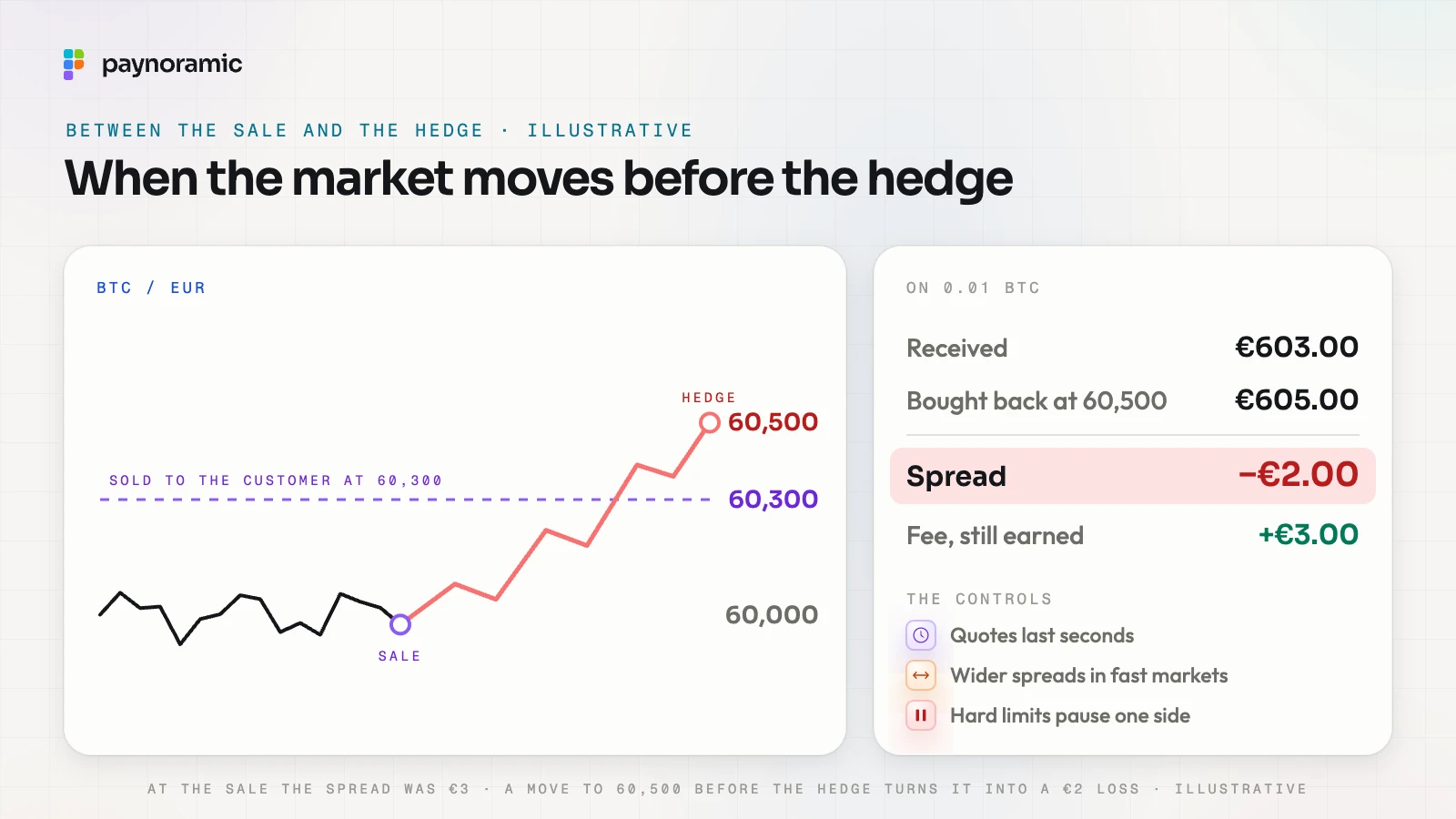
The controls are set by the operator, per asset:
Short validity. Quotes last seconds, and an expired quote is never honoured at its old price.
Wider spreads in fast markets. The spread grows with volatility and with the size asked for.
A stale price stops quoting. If the live market price has not updated, or the hedging venue is unreachable, the operator stops offering firm prices rather than quote blind.
Size limits. A maximum per quote, per customer and per day, with larger requests sent to a desk.
Hard inventory limits. At 1.50 BTC in the example, the operator stops selling bitcoin and keeps buying it from customers until a hedge brings the inventory back.
Assets can also be restricted as a whole. In Marengo, staff can mark a stablecoin allowed, exit only or blocked, each decision needing two different people, and the restriction holds in the broker as it does in trading.
The licensing questions it raises
In the EU, broker mode is a regulated service under the Markets in Crypto-Assets Regulation (MiCA). This is general information, not legal advice. MiCA defines "exchange of crypto-assets for funds" as "the conclusion of purchase or sale contracts concerning crypto-assets with clients for funds by using proprietary capital" (Article 3(1), point 19): exactly what an operator selling from its own inventory does. A broker that passes orders to a venue in the customer's name is instead executing orders on behalf of clients (point 21), and running an order book is the operation of a trading platform (point 18).
No one may provide crypto-asset services in the EU without authorisation as a crypto-asset service provider, or without being one of the financial entities MiCA lets in another way (Article 59). For the brokers and banks this guide is written for, that other way matters: a credit institution may provide crypto-asset services after notifying its regulator at least 40 working days before it starts, and an investment firm may provide those equivalent to the investment services it is authorised for, with the exchange of crypto-assets for funds counted as equivalent to dealing on own account (Article 60).
MiCA then sets rules that shape the quote itself (Article 77):
a non-discriminatory commercial policy saying which clients the operator will deal with and on what conditions;
a published firm price, or a method for determining the price, and any limit on the amount;
execution "at the prices displayed at the time when the order for exchange is final", with clients told when their order is deemed final;
published information about the transactions concluded, such as volumes and prices.
The operator also has to publish its policies on pricing, costs and fees in a prominent place on its website (Article 66(4)), and identify, prevent, manage and disclose its conflicts of interest with clients, which an operator trading against its own customers plainly has (Article 72). A provider authorised for exchange of crypto-assets for funds is in Class 2, with permanent minimum capital of 125,000 euros (Annex IV).
The guide to starting a crypto OTC desk compares these services for principal and agency desks in the EU, the UK and Dubai, and the guide to licensing a brokerage app in the EU covers the investment-firm side. With Paynoramic's software, the licence and the inventory are the operator's: Paynoramic builds and hands over the software, and holds no licence or inventory of its own.
Frequently asked questions
Is broker mode the same as an OTC desk? The mechanism is the same: a request, a firm quote and an acceptance. An OTC desk usually serves companies trading large sizes, often with a person in the loop, while broker mode inside an app serves retail customers automatically, in small sizes, in seconds.
Can the operator change the price after the customer accepts? No. Under MiCA the order is executed at the price displayed when it became final. A quote that has expired is not accepted; the customer gets a new one.
Does a broker need its own order book as well? No. Broker mode works without one, with the operator hedging at outside venues. Many operators add an order book later for active traders, which in the EU is a separate service: the operation of a trading platform.
Where does the operator's margin come from? From the spread between the market price and the quoted price, and from any fee shown before Accept. Hedging costs and moves against the inventory come out of it.
See it working
Broker mode is easiest to judge in a working app. Open Marengo at marengo.paynoramic.com to see Lite and Pro, or read how our white-label crypto exchange is built and handed over to the licensed operator who runs it.