How do crypto exchanges make money? Fees, spreads and other revenue
Mostly from trading fees and the spread on instant buys, then withdrawal fees, staking commissions, interest on cash, cards, OTC and data. Volume decides whether that beats the fixed costs.
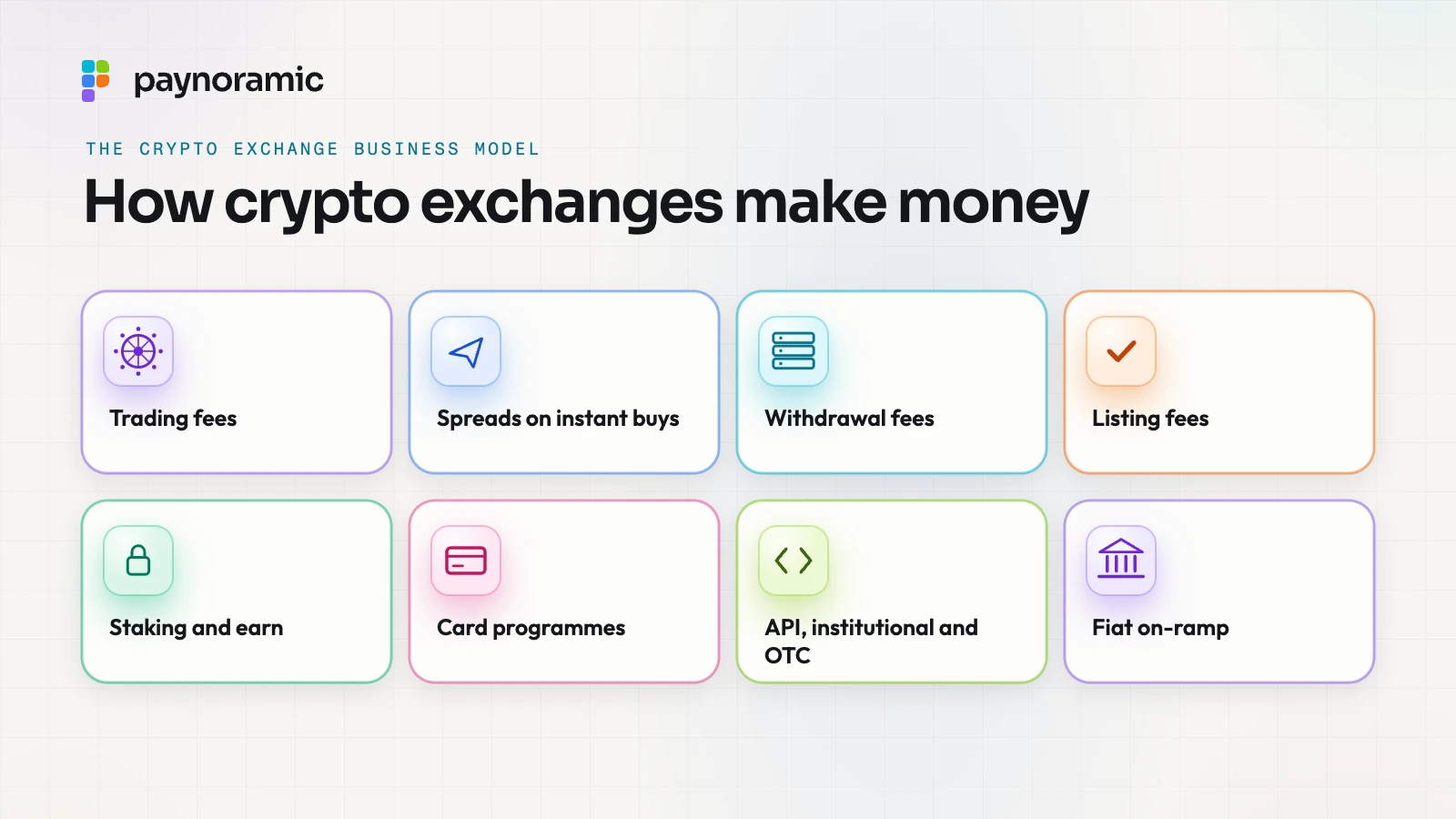
How do crypto exchanges make money? Mostly by charging a fee on every trade matched on their order book and by building a margin into the price of instant buys and sells. Around that core sit withdrawal fees, staking commissions, interest on customer cash, card programmes, OTC desks and market data. Each line is small per transaction, so the business model works only when enough volume passes through to cover fixed costs that are large from the first day.
This guide is general information, not legal or financial advice. All numbers in the examples are hypothetical round figures chosen to show the arithmetic, not market rates or any exchange's prices.
How do crypto exchanges make money from trading fees?
On an order book exchange, a buyer and a seller trade with each other and the exchange charges both of them. The matching engine pairs the orders; the fee is taken from each side's proceeds and recorded on the ledger with the fill.
Many exchanges use a maker-taker schedule. A maker places an order that rests on the book and adds liquidity; a taker places an order that fills at once against it and removes liquidity. Takers usually pay more, because resting orders are what make the market usable.
Example (hypothetical). The schedule is 0.10% for makers and 0.20% for takers. A seller has a limit order resting on the book; a buyer sends a market order that fills it for €10,000.
The buyer, as taker, pays €20.
The seller, as maker, pays €10.
The exchange earns €30 on a €10,000 trade, or 0.30% of its value.
Fees then fall with volume through fee tiers: a customer trading more than a set amount over 30 days might pay 0.05% as maker and 0.10% as taker, and the largest market makers nothing at all. The exchange gives up margin on that flow to keep its bid-ask spread tight, which brings in the takers who pay full price.
In the EU, MiCA requires a trading platform's fee structures to be transparent, fair and non-discriminatory, and not to reward placing or cancelling orders in a way that contributes to disorderly trading or market abuse (Article 76(13)). Every provider must also publish its pricing, costs and fees policies prominently on its website (Article 66(4)).
How do crypto exchanges make money on instant buys? The spread
In a simple buy flow the customer never sees the order book: they type an amount and get a quote, a little above the market for a buy and a little below it for a sell. That gap is the exchange's margin, and per euro it is usually worth more than an order book fee.
Example (hypothetical). Bitcoin trades at €50,000 on the order book. A customer asks to buy €1,000 of it in the simple app.
The app quotes €50,500 per bitcoin, 1% above the market, and shows the customer 0.0198 BTC.
The customer confirms, and the exchange sources the bitcoin at around €50,000, for about €990.
The difference, about €10, is the exchange's revenue: five times what a 0.20% taker fee would have earned on the same €1,000.
MiCA treats this as its own service, the exchange of crypto-assets for funds. The provider publishes a firm price or its pricing method, and executes at the price displayed when the order became final (Article 77(2) and (3)). An operator of a trading platform may not deal on its own account on the platform it operates, including when it provides that exchange service (Article 76(5)), so the instant buy desk is designed around that rule.
The margin carries risk: between quote and fill the market can move, and on a fast day a 1% spread can shrink to nothing.
Deposit and withdrawal fees, against network fees
Crypto deposits are usually free to the customer, who pays the network when sending. Withdrawals are where the exchange charges, because each one costs it a network fee paid to the blockchain's validators or miners.
Example (hypothetical). The exchange charges a flat 0.0002 BTC to withdraw bitcoin. On a quiet day, it batches 50 withdrawals into one transaction whose network fee is 0.002 BTC, or 0.00004 BTC per withdrawal. It keeps the difference, 0.00016 BTC each, but on a congested day the same transaction can cost ten times more and the flat fee may not cover it.
Fiat works differently. A bank transfer may cost the exchange very little, while a card deposit carries acquiring fees and the risk of chargebacks, so exchanges often charge a percentage on card top-ups and nothing on bank transfers.
Listing fees, and the conflict they create
Some exchanges charge a token's issuer to admit it to trading. MiCA does not ban this: a trading platform's operating rules must set out the policies, procedures and level of fees, if any, for admission to trading (Article 76(1)(c)).
A fee does not buy a listing. Before admitting a crypto-asset, the operator assesses its suitability, including the reliability of its technology and any association with illicit or fraudulent activity (Article 76(2)). A fee paid by the party being assessed is an obvious conflict, and MiCA requires every provider to identify, prevent, manage and disclose conflicts of interest, and to publish their nature and the steps taken to mitigate them (Article 72).
Staking and "earn" products
On proof-of-stake networks, tokens locked for validation earn rewards. An exchange can stake customers' tokens through validators and keep a share of the rewards as a commission.
Example (hypothetical). Customers stake €1 million of a token whose network pays 4% a year. The rewards come to €40,000; the exchange passes €30,000 to customers and keeps €10,000, a 25% commission.
The regulatory ground is uneven:
EU. Staking is not one of the crypto-asset services MiCA lists (Article 3(1)(16)), and MiCA says it does not address the lending and borrowing of crypto-assets, which stay with national law (Recital 94). A provider holding clients' crypto must still prevent its use for its own account (Article 70(1)).
Stablecoins in the EU. Providers may not grant interest when providing services related to e-money tokens or asset-referenced tokens, and any remuneration or benefit linked to how long a holder keeps the token counts as interest (Article 50 and Article 40). An "earn" product that pays customers for holding either kind of stablecoin falls within that ban.
UK. The Cryptoassets Regulations 2026 make arranging qualifying cryptoasset staking for others a regulated activity, needing FCA authorisation, from 25 October 2027.
Interest on customer cash
Customers leave euros on the exchange between trades, and that cash sits in a bank account that may pay interest.
Example (hypothetical). Customers hold €20 million in cash on the exchange on average. If the bank pays 2% a year on the account, that is €400,000 a year.
MiCA sets the conditions, not the split. A provider holding clients' funds must prevent their use for its own account, place them with a credit institution or a central bank by the end of the next business day, and keep them in an account separately identifiable from its own (Article 70(2) and (3)). Article 70 does not say who keeps the interest; that follows from the bank's terms, the client agreement and national law.
Card programmes
A crypto card lets customers spend their balance wherever cards are accepted. The exchange runs it with a licensed card issuer and earns from the conversion, from card fees and from a share of interchange, the fee the merchant's side pays the issuer on each payment.
Example (hypothetical). A customer pays €100 in a shop with a card funded by selling crypto at a 1% spread. The exchange earns €1 on the conversion. Interchange on that payment is capped in the EU at 0.2% for consumer debit and prepaid cards (Article 3 of the Interchange Fee Regulation) and 0.3% for consumer credit cards (Article 4), so at most €0.20 here, shared between the issuer and the exchange under their contract.
The cap applies where both sides' payment service providers are in the EU (Article 1), so here the conversion earns five times the most interchange could.
Institutional, API and OTC revenue
Professional clients trade through the API, pay less per trade and trade in size:
Tiered fees and market making. Market makers pay little or nothing for keeping the book deep. How those agreements work is in liquidity and market makers for a crypto exchange.
OTC. A desk quotes large blocks off the order book. Example (hypothetical): a fund buys €500,000 of bitcoin at a 0.15% margin, and the desk earns €750. Licensing is covered in crypto OTC desks and RFQ.
Market data. In the EU, a trading platform publishes its prices, depth and trades, may sell that data in real time on a reasonable commercial basis, and makes it free 15 minutes after publication (Article 76(9) to (11)).
Fiat on-ramp
The on-ramp is the path from a bank account or card into crypto, and each step can carry a fee: the deposit, the conversion and the spread. Some exchanges also offer their on-ramp to other apps, earning a fee on each purchase. Under MiCA, the exchange may provide the payment services involved itself or through a third party, provided one of them is authorised under the Payment Services Directive (Article 70(4)).
The crypto exchange business model: the costs that eat into revenue
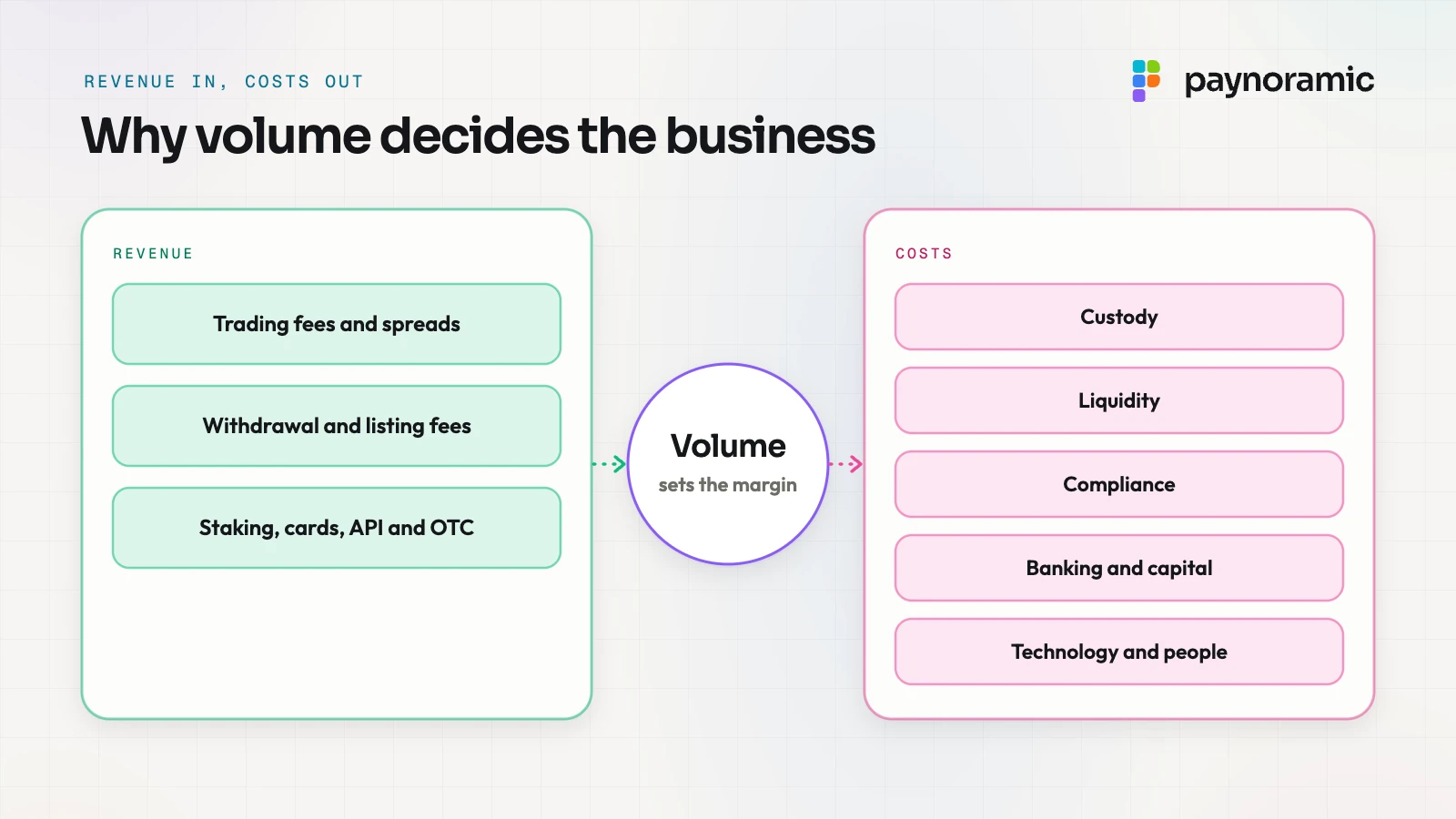
Revenue scales with volume; most costs do not. These are the lines that decide the margin:
Custody. A custodian's fees, or the exchange's own key infrastructure and insurance, plus network fees to sweep deposits into its wallets. See hot, cold and MPC custody.
Liquidity. Market makers' agreements, and the cost of hedging instant buy flow.
Compliance. Identity checks, wallet screening, Travel Rule messaging, a compliance team, audits and reports.
Banking. Client accounts, payment providers' fees and card chargebacks.
Capital. Under MiCA, an operator of a trading platform keeps prudential safeguards of at least €150,000, or a quarter of the previous year's fixed overheads if that is higher (Article 67 and Annex IV).
Technology and people. Hosting, security, support and engineering.
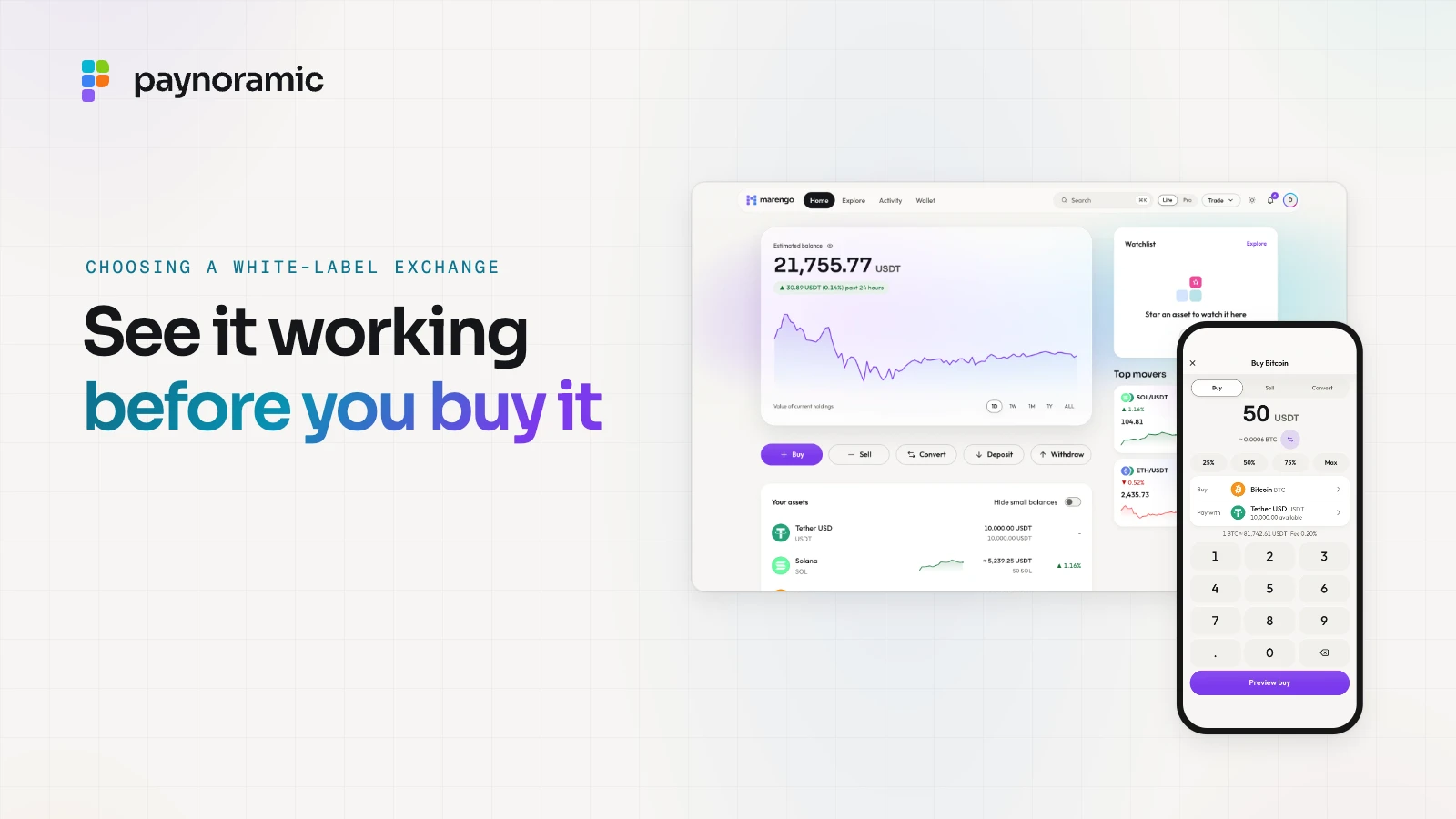
How these add up before launch is in what it costs to launch a crypto exchange. To see where fees and spreads appear in a real product, you can see a working exchange in Marengo.
Why volume decides crypto exchange revenue
Fixed costs arrive before the first customer, and fees are fractions of a percent.
Example (hypothetical). An exchange's fixed costs are €300,000 a month. Across makers, takers and tiers it earns 0.20% of the value of each trade, both sides counted. It needs €150 million of matched volume a month to break even, before any spread, staking or interest income.
Volume also feeds itself. More traders mean a deeper book and tighter spreads, which attract more traders and market makers, while a thin book drives them away. This is one reason a new exchange may lean on the higher-margin lines first, instant buys, cards and on-ramps, while the order book builds depth.
Frequently asked questions
What is the biggest source of revenue for a crypto exchange?
Trading, in the form of order book fees and the spread on instant buys and sells. Which of the two is larger depends on the customer base: an exchange whose customers mostly use instant buys earns more from spreads, one serving professional traders from fees on high volume.
Do crypto exchanges make money when prices fall?
Yes, as long as people trade. Fees are charged on sells as well as buys, so revenue follows trading activity rather than the direction of prices.
Why is the instant buy price higher than the order book price?
The quote includes the exchange's margin and covers the risk that the market moves before the order is filled. In the EU, the provider must publish the price or its method and execute at the price displayed when the order became final (MiCA, Article 77).
Can an exchange pay interest on stablecoins in the EU?
Not on e-money tokens or asset-referenced tokens. MiCA bars providers from granting interest when providing services related to them, and treats any benefit tied to how long a customer holds the token as interest (Articles 40 and 50).
Do exchanges charge to list tokens?
Some do. MiCA allows admission fees if they are set out in the platform's operating rules, but the token must still pass the operator's suitability assessment, and the conflict of interest has to be managed and disclosed (Articles 72 and 76).
See a working exchange
Every line above runs through the same software: a matching engine for fees, a ledger that records each one and wallets that settle them. A working white-label exchange shows how it fits together, and you can try it at marengo.paynoramic.com, then read what is handed over on the crypto exchange page.