Choosing a white-label crypto exchange: 12 questions to ask a vendor
Twelve questions that separate white-label crypto exchange vendors: who owns the code, what it costs over time, whether the ledger reconciles, who holds the keys and what the licence still needs.
The questions that separate white-label crypto exchange vendors cover five things: what you own and pay for over time, whether the money stays correct when something fails, who holds the keys, which compliance controls are built, and what still runs on someone else's clock. Each one can be answered with evidence: a working exchange, a reconciliation run, a contract clause. The twelve questions below follow that order, each with why it matters and what a good answer looks like.
This guide is general information, not legal advice. Which rules apply depends on the services offered and where the exchange operates.
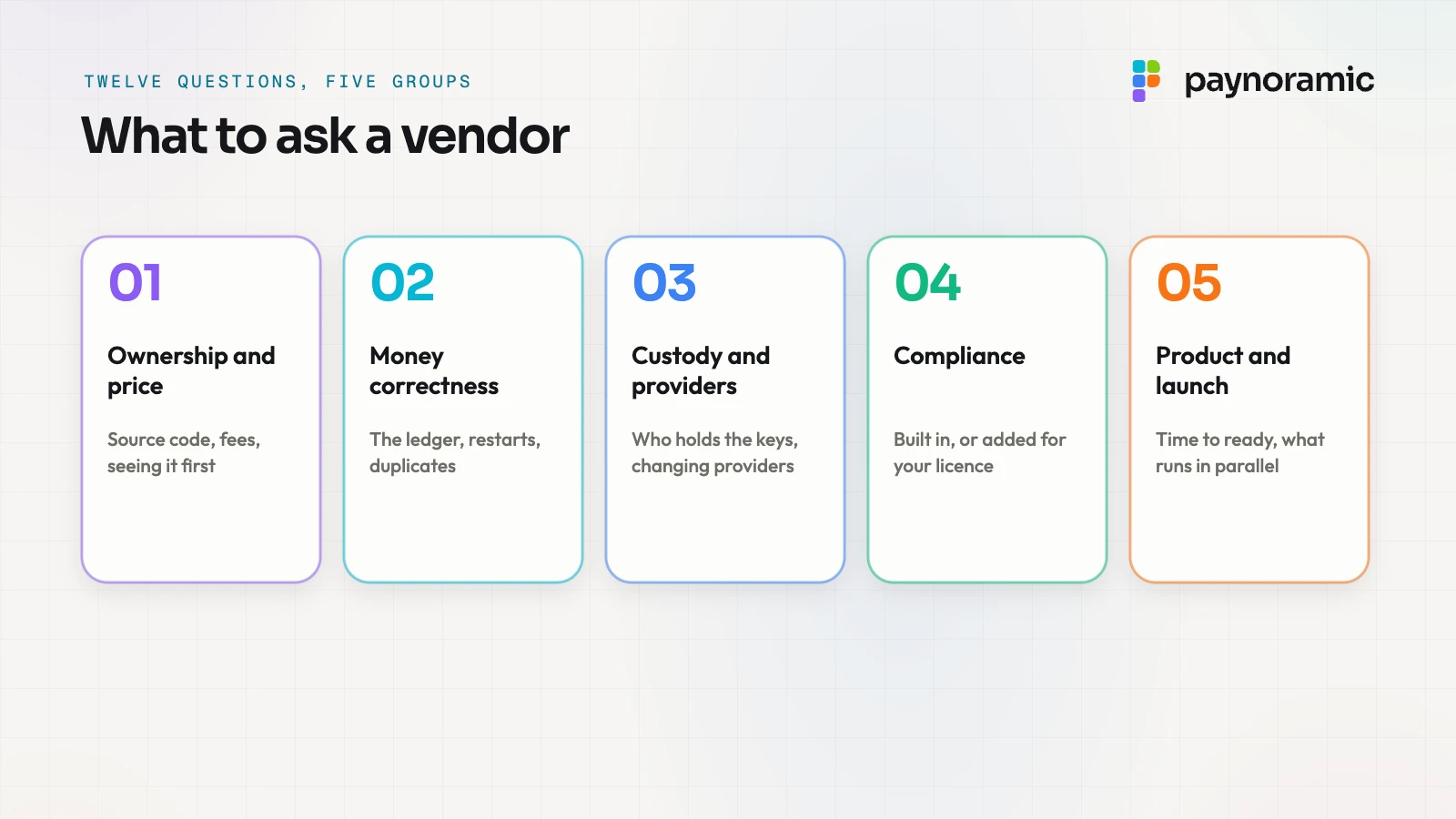
Ownership and price
1. Do I get the source code, and what is in it?
Why it matters. A white-label exchange can be a platform rented under your brand or one you take over. Without the code, every change, fix and audit runs through the vendor, and so does any exit. The guide to building, renting or buying a platform compares the routes.
A good answer. A list of what is handed over, by component: matching engine, wallets, ledger, API, apps and backoffice, with infrastructure configuration and documentation. It says when the code is handed over and whether your own developers may change any part of it.
2. Is there a licence fee or a revenue share, and what does leaving cost?
Why it matters. A fee per trade or a share of revenue grows with volume for as long as the exchange runs. The real cost of leaving usually sits in the data and the migration, not in the termination clause.
A good answer. The price in writing, split into one-off and recurring costs, with each recurring cost named: hosting, support, provider contracts. It also states what stays with you if the relationship ends. The guide to what it costs to launch an exchange covers the budget around the software.
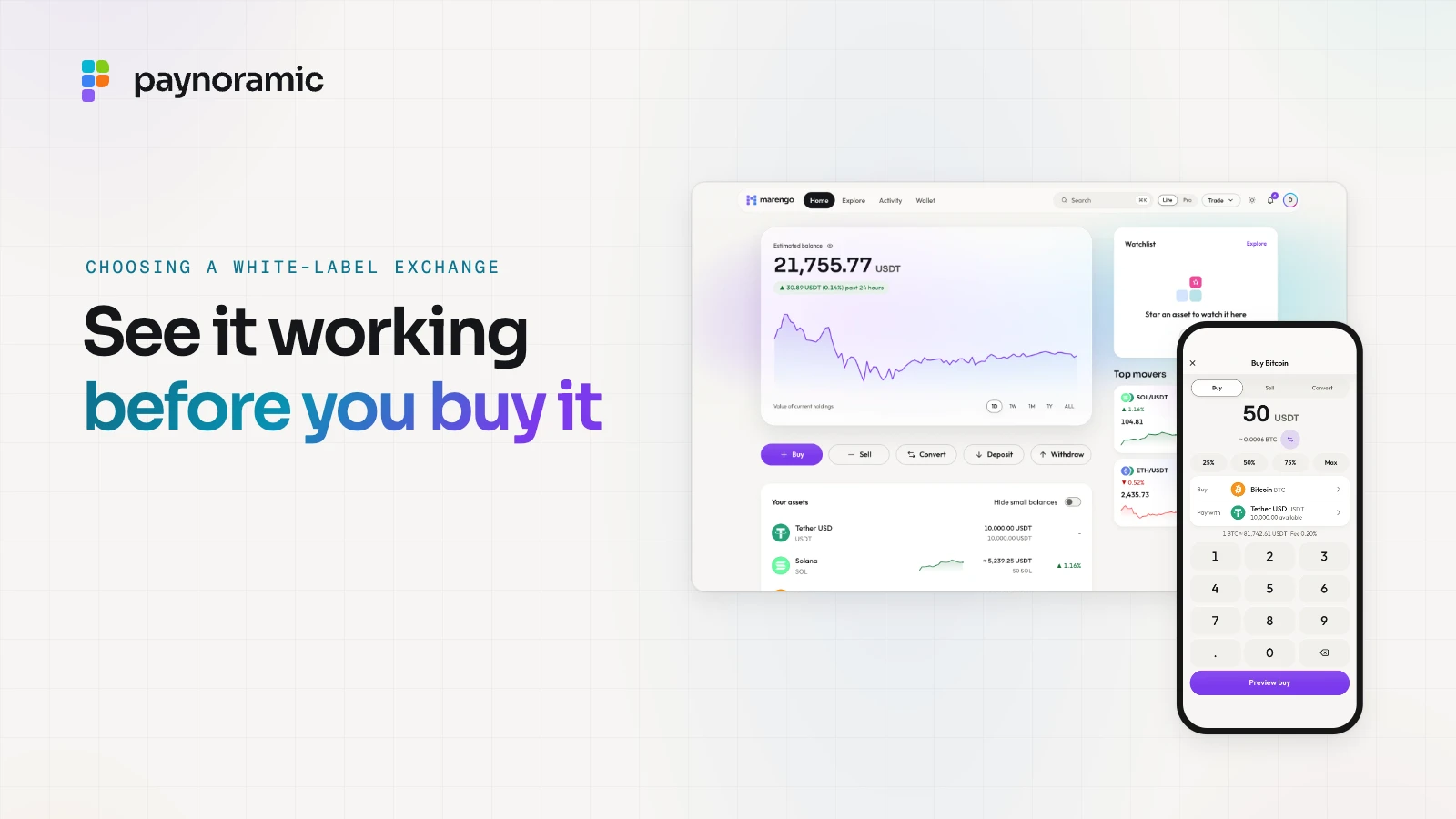
3. Can I see it working before I sign?
Why it matters. Screens in a deck show a design, not an exchange. A running system shows whether orders match, balances move and staff can review a user.
A good answer. An exchange you can open and use yourself, on a phone and a computer, plus a walk-through of one trade from the order to the ledger entry, with the backoffice shown too.
Money correctness
4. How does the ledger reconcile?
Why it matters. An exchange's balances are its customers' money. If the record of who owns what drifts from what the wallets and the bank hold, the gap tends to surface at a failed withdrawal or an audit.
In the EU, MiCA (Article 75) requires a provider holding clients' crypto to keep a register of positions in each client's name, record their movements as soon as possible, and send each client a statement of position at least once every three months.
A good answer. A double-entry ledger in which every movement is recorded twice and balances per asset, with funds held against open orders. A reconciliation checks every account and reports any difference; a vendor can show one run after trading, deposits and withdrawals.
5. What happens if the matching engine restarts?
Why it matters. The matching engine keeps the order book in memory. A restart that loses resting orders, or applies a fill twice, corrupts balances within seconds.
A good answer. The engine is deterministic, so the same inputs always produce the same book. It rebuilds its state from a snapshot, replays its log from that point, and processes each order exactly once.
6. How are duplicate or lost events handled?
Why it matters. An exchange is several services passing messages: a fill to the ledger, a deposit to a balance, a withdrawal to custody. Networks retry, so a message can arrive twice, or a change can be saved without its message ever being sent.
A good answer. Each service writes its change and the event announcing it in one database transaction (the transactional outbox pattern), and every consumer recognises and ignores a duplicate. A deposit credited twice is then prevented by design rather than found later.
Custody and providers
7. Who holds custody and the keys?
Why it matters. Holding clients' crypto is a licensed activity and the largest single risk. MiCA Article 75 requires client crypto to be segregated from the provider's own, on the distributed ledger too, and legally protected from the provider's creditors in insolvency. It also makes the custodian liable for losses attributable to it, up to the market value of what was lost.
A good answer. A clear statement of who holds the keys: the licensed exchange, a custodian it appoints, or its own HSMs or MPC set-up, and never the software vendor by default. It also explains how a withdrawal is approved before it leaves.
8. Can I change the custodian or KYC provider without a rebuild?
Why it matters. Providers change prices, leave markets, or decline to onboard a business in a given jurisdiction. Where a provider's code is spread through the platform, replacing it becomes a project.
A good answer. Each provider sits behind an interface in the platform's own terms, so a change is one adapter and its configuration. The vendor separates the providers connected today from those it would add for your launch, since these are two different lists.
Compliance
9. Which compliance controls are built, and which are added for my licence?
Why it matters. Regulators authorise the operator, not the software, but they examine the controls the software runs. The gap between "built" and "planned" is where launch dates slip.
In the EU, the Transfer of Funds Regulation has applied since 30 December 2024. Its Article 14 requires transfers of crypto to carry information on the sender, such as the name and the ledger address: the Travel Rule.
A good answer. Two lists. The first is built and can be shown working, such as identity checks, withdrawal limits and an audit log; the second is added for the licence, such as sanctions and wallet screening, transaction monitoring, Travel Rule messaging and regulatory reports. The MiCA checklist covers the rest of the EU regime.
10. What will the contract give my regulator?
Why it matters. Under MiCA Article 73, a provider that outsources stays fully responsible, keeps direct access to the outsourced information, and needs an outsourcing policy with exit strategies and a written agreement it can terminate. DORA, which covers authorised providers of crypto services (Article 2) and has applied since 17 January 2025, adds rules for every contract for ICT services:
Article 30 requires, among other things, the locations where data is processed, the return of data if the supplier fails or the contract ends, cooperation with the regulator, and termination rights.
For services supporting critical or important functions, Article 30 adds rights of access, inspection and audit, and an exit strategy with a transition period.
Article 28 requires exit plans for those services that are documented and tested.
A good answer. A vendor that knows these rules and can show the clauses that meet them. A vendor that hands over the code and runs nothing has a smaller role to describe than one that hosts the exchange. The UK and the UAE have their own regimes; see the guide to FCA cryptoasset registration.
Product and launch
11. How long until the software is ready, and what runs in parallel?
Why it matters. The software is rarely the slowest part. The licence, a custodian's onboarding, a bank account for client money and liquidity agreements each run on their own timetable.
A good answer. A date for the software alone, kept apart from the date customers can trade, and a plan that starts the licence, custody, banking and liquidity work at the same time.
12. How is it tested, and how does it behave under stress?
Why it matters. MiCA Article 76 requires an EU trading platform's systems to be resilient, to cope with peak volumes, to keep trading orderly under severe stress, and to reject orders above pre-set price and volume thresholds or clearly erroneous ones. The systems must also be fully tested and covered by business continuity arrangements.
A good answer. Numbers on the automated tests and what they cover, a price band per market that stops orders far from the price, and a way for staff to halt a market. The vendor also states what capacity has been measured, rather than what is hoped for.
How Paynoramic's exchange answers them
Paynoramic builds the exchange and hands it over; it holds no licence and does not operate exchanges. The client is the licensed operator. Marengo is the same software in its own brand, so each answer below can be checked there.
Question | Paynoramic's answer |
|---|---|
See it working | Open Marengo at marengo.paynoramic.com, or book a 15-minute live demo that includes the backoffice. |
Ledger | Double-entry, balanced per asset, funds held per order, and a reconciliation that checks every account. It passed after trading, deposits and withdrawals. |
Engine restart | A deterministic engine processes each order exactly once and recovers from snapshots by replaying its log. |
Custody and keys | Held by the client or a custodian it appoints, never Paynoramic: a custodian such as Fireblocks or BitGo connected for the launch, or the client's own HSMs or MPC cluster. Withdrawals pass approval rules and daily limits by verification level. |
Changing providers | Every provider sits behind an adapter, and the build fails if a provider's name appears outside it. A new provider is one adapter and configuration, in one service. |
Compliance | Built: identity checks through Paynoramic KYC, withdrawal rules, a market halt on a sharp price move and a full audit log. Added for the licence: sanctions and wallet screening, transaction monitoring, Travel Rule messaging, MiCA, DAC8 and CRS reports, proof of reserves reporting and market surveillance. |
Launch time | About 30 days for the software on the ready path; the licence, custodian, bank and liquidity run alongside and often take longer. |
The providers connected in Marengo today are listed on the crypto exchange page, beside those added for a client's launch, and every provider has its own page under connectors. Custody is covered on the custody and wallets module.
These twelve questions work with any vendor, and a good one will welcome them. To see how one exchange answers them in practice, open Marengo at marengo.paynoramic.com on a phone or a computer, or read more about the crypto exchange.