Market makers and liquidity: how a crypto exchange gets a tight spread
A tight spread comes from market makers, separate firms whose software quotes both sides of the order book over the exchange's API, re-quotes as prices move and works under its own agreement.
A crypto exchange has a tight spread when someone keeps buy and sell orders resting close to the price, in size, all day. On most exchanges that someone is a market maker: a separate firm whose software quotes both sides of the order book over the exchange's API, and re-quotes every time the price moves elsewhere. This guide explains what liquidity means, how a market maker works and what it risks, and why each one comes under its own agreement, fitted to the operator's licence.
What liquidity means: spread and depth
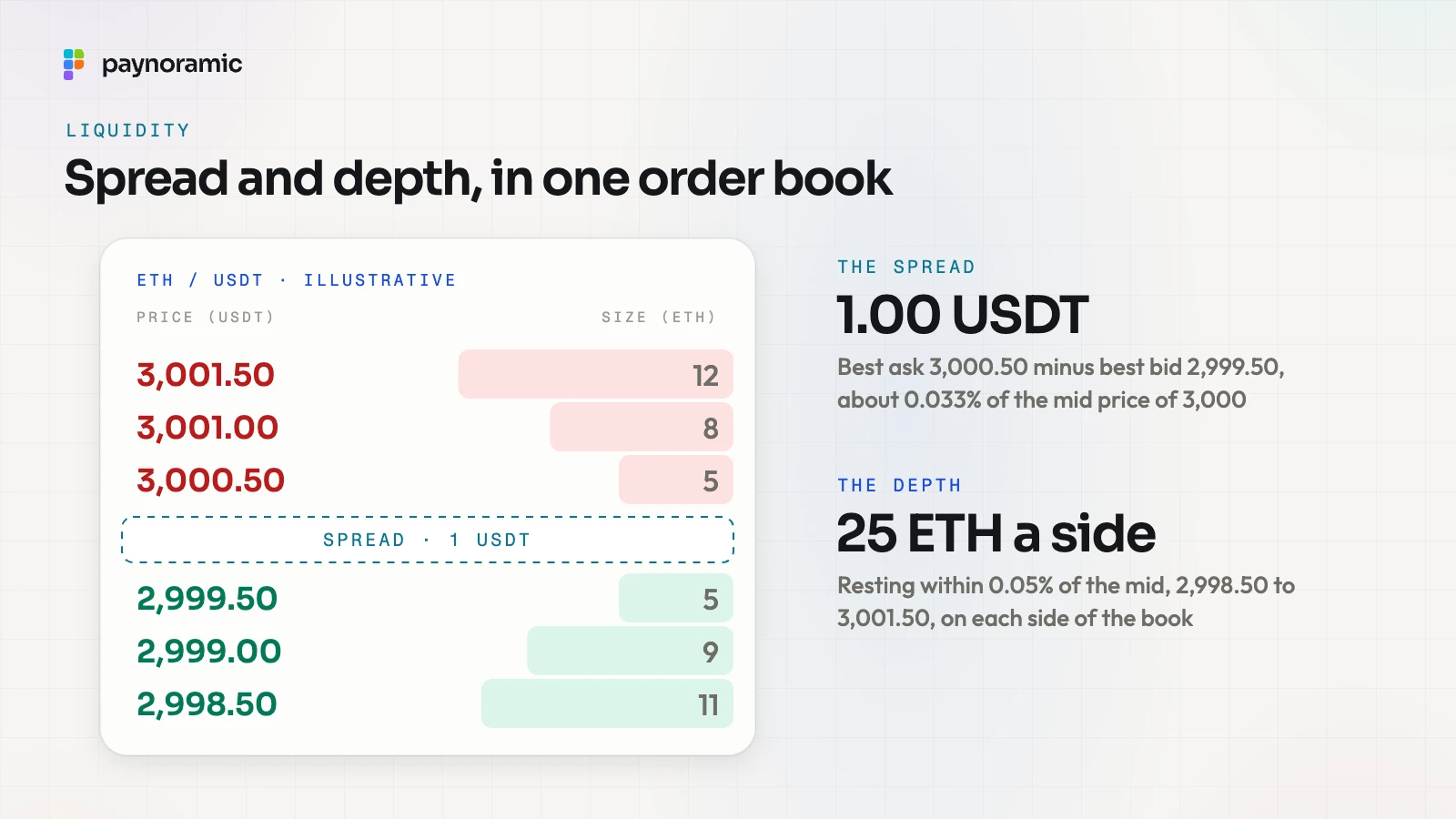
Liquidity is how much can be bought or sold quickly without moving the price. On an order book it shows in two numbers.
The spread is the gap between the best bid, the highest price a buyer is offering, and the best ask, the lowest price a seller will take. A narrow bid-ask spread means a trader pays little over the middle price.
The depth is how much is waiting near the price. A deep book absorbs a large order without running through many price levels.
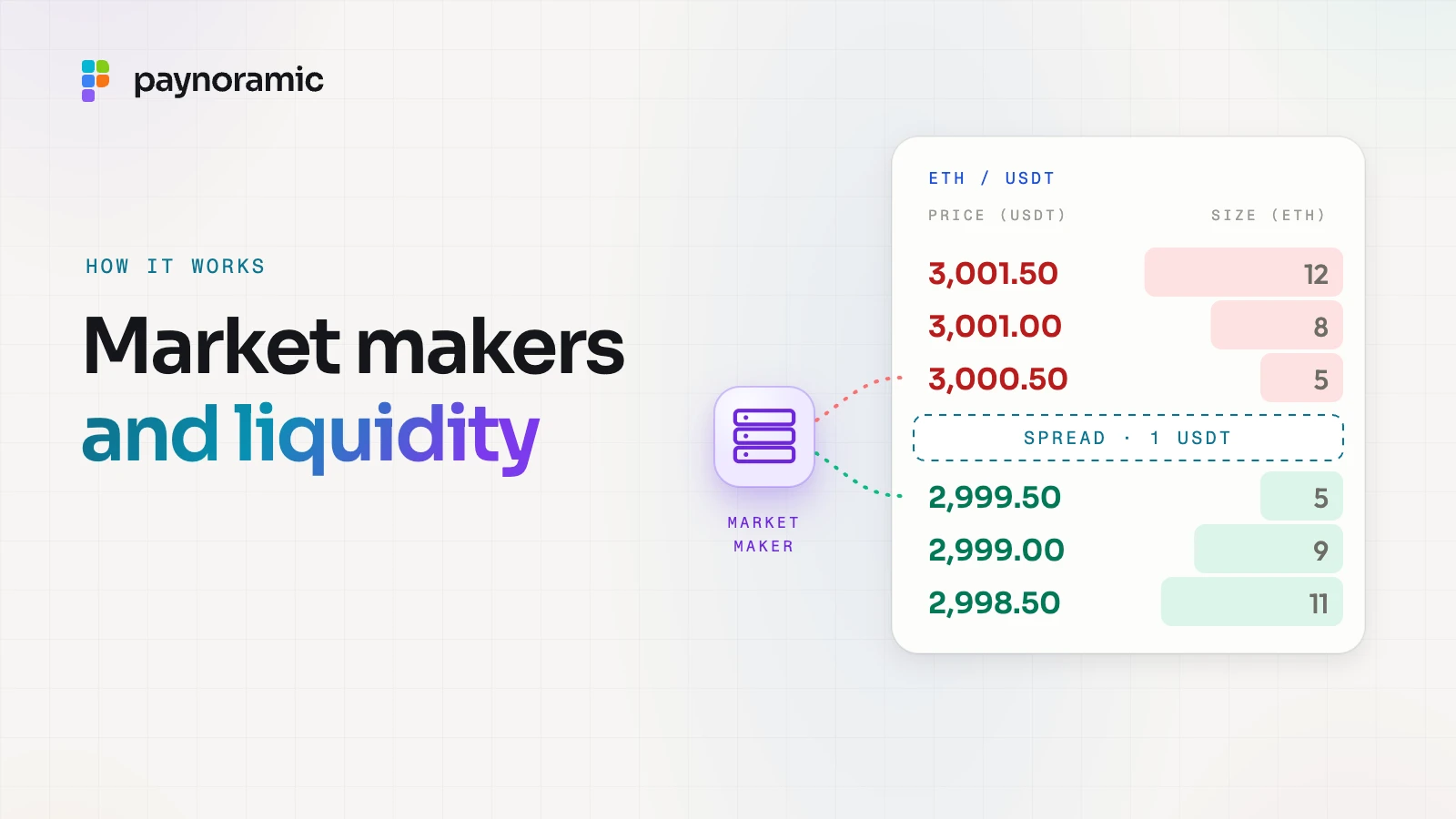
Take an illustrative ETH/USDT market with the best bid at 2,999.50 and the best ask at 3,000.50. The spread is 1.00 USDT, about 0.033% of the mid price of 3,000. Within 0.05% of the mid, from 2,998.50 to 3,001.50, 25 ETH rests on each side.
Both numbers are public. In the EU, a trading platform makes public its bid and ask prices and "the depth of trading interests at those prices", continuously during trading hours (MiCA, Article 76(9)). Spread and depth are what a trader sees first, and they decide whether the trader stays.
Who puts the orders there
Some resting orders come from ordinary users who place an order at a price and wait. On their own they rarely make a book deep and tight in every market, around the clock: they arrive when they choose, at the prices they choose.
A market maker fills that gap on purpose. It is a trading firm that keeps a bid and an ask on the book at the same time, usually at several price levels, and earns from the difference as buyers and sellers trade against it. To the exchange it is a participant like any other, with its own account, its own balances and its own connection to the API.
How a market maker quotes both sides
A market maker starts from a reference price: its own estimate of what the asset is worth right now, usually built from prices on the other markets it follows. Around that price it places its quotes.
In our example the reference price is 3,000.00. The market maker bids 2,999.50 and asks 3,000.50, with more size at prices further out. When a seller sells to its bid and a buyer buys from its ask, it has bought and sold the same amount 1.00 USDT apart, and that gap, repeated over many trades, is its income before fees.
The quotes are never set once. The market maker's software runs a short loop all day:
Read the reference price from the markets it follows.
Work out new quotes, given its inventory and how fast the market is moving.
Cancel the old orders and place new ones wherever the quotes have changed.
Read its fills as they happen, and update its inventory.
Re-quoting as the price moves
Say the price on other markets jumps to 3,006.00. The market maker cancels its bid at 2,999.50 and its ask at 3,000.50, and posts a new bid at 3,005.50 and a new ask at 3,006.50.
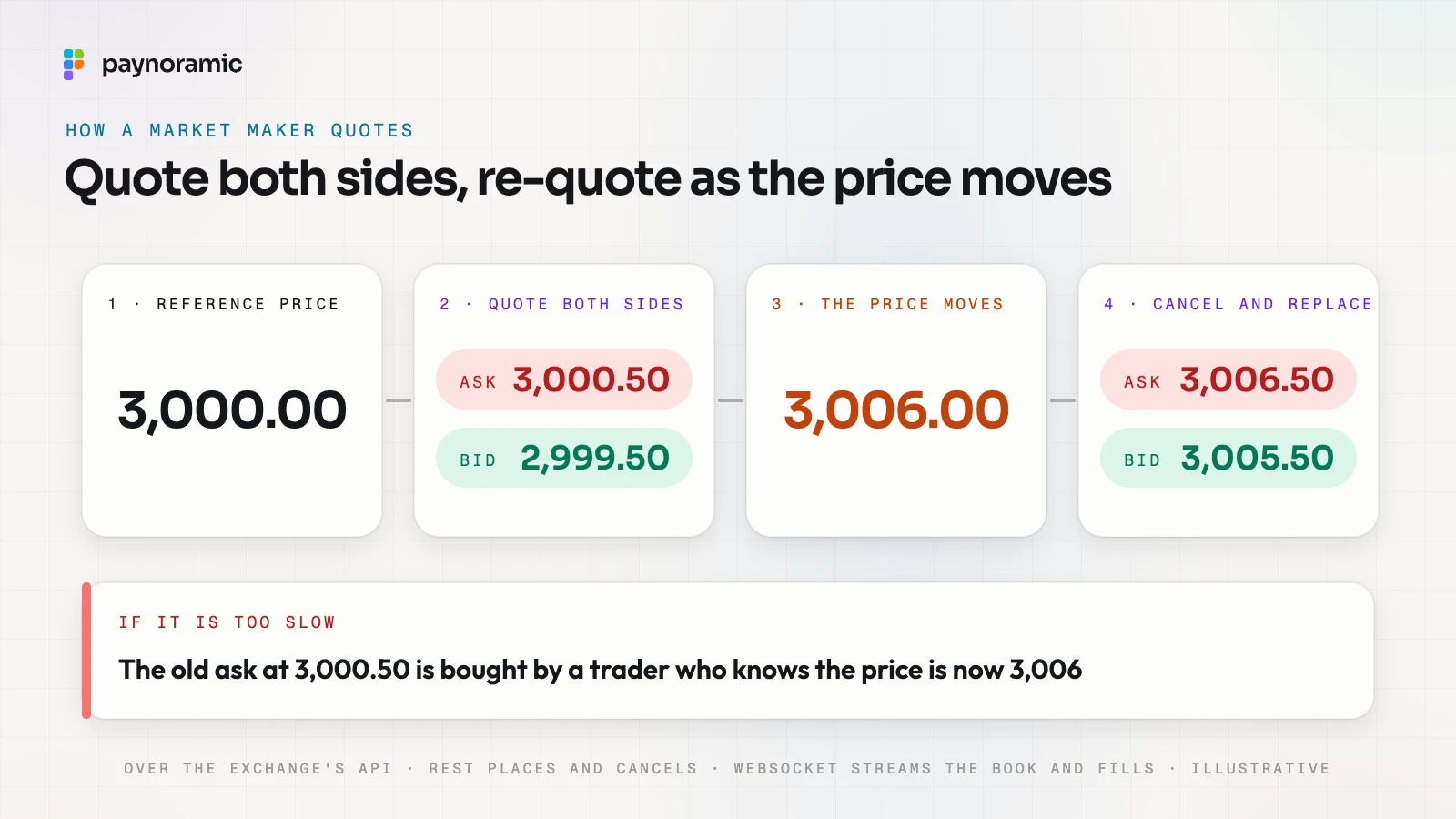
Speed matters here. If the old ask is still on the book after the move, a trader who has seen the new price buys it at 3,000.50, and the market maker has sold 5.50 USDT below the market. Being picked off like this is the main cost of quoting, which is why re-quoting is done by software, continuously, rather than by hand.
Over the exchange's API
Market makers do not trade from the screen. Their software connects to the exchange's API, usually over two channels:
REST requests to place and cancel orders and to read balances, one request at a time.
A WebSocket stream that pushes changes to the book, new trades and the market maker's own fills as they happen, so its software never has to ask.
A market maker cares that orders are acknowledged quickly, that cancellations are dependable and that the stream never misses an update. The exchange, for its part, commonly issues API keys per participant, with rate limits that protect the matching engine and permissions that let a key trade without letting it withdraw. In the exchange software Paynoramic builds and hands over, the REST and WebSocket API that the apps use is the same one market makers trade over.
Maker and taker
The order that rests on the book is the maker; the order that trades against it at once is the taker. A market maker is, by design, mostly a maker: it adds the liquidity that takers remove.
Many exchanges charge makers less than takers, or move large makers to lower fee tiers, to reward keeping the book full. How those schedules are built, and what MiCA says about them, is in how crypto exchanges make money. How a taker's order is matched against resting orders, price first and then time, is in what happens when you press Buy.
How a thin book causes slippage
Slippage is the difference between the price a trader expected and the average price they got. It comes from depth: an order larger than the best ask takes the next price level, and the next, until it is filled.
Here is the same market buy of 10 ETH on two books with the same best ask of 3,000.50. At that price, 10 ETH would cost 30,005.00 USDT.
Deep book | Thin book | |
|---|---|---|
Fills | 5 at 3,000.50, 5 at 3,001.00 | 1 at 3,000.50, 2 at 3,004.00, 3 at 3,010.00, 4 at 3,018.00 |
Total paid (USDT) | 30,007.50 | 30,110.50 |
Average price (USDT) | 3,000.75 | 3,011.05 |
Over the best ask (USDT) | 2.50 | 105.50 |
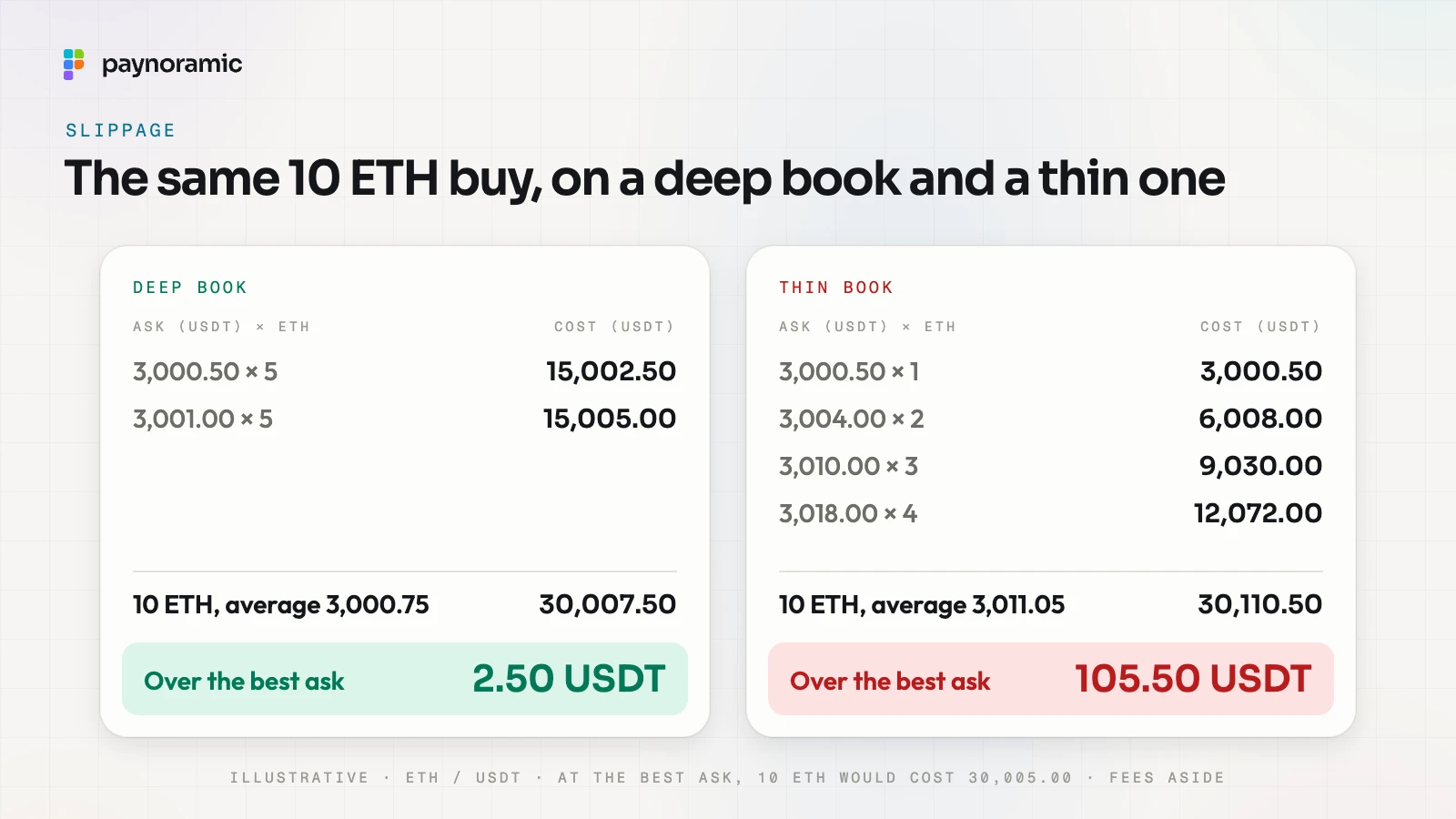
On the thin book the buyer pays about 42 times as much over the best ask, before any fee. Thin books also tend to have wide spreads, so the cost starts before the first fill. That is the practical case for market makers: a trader who meets a thin book once often does not come back.
Inventory risk
A market maker earns the spread only while buyers and sellers arrive in balance. When the flow runs one way, it builds up a position it did not choose, and that position is exposed to the price.
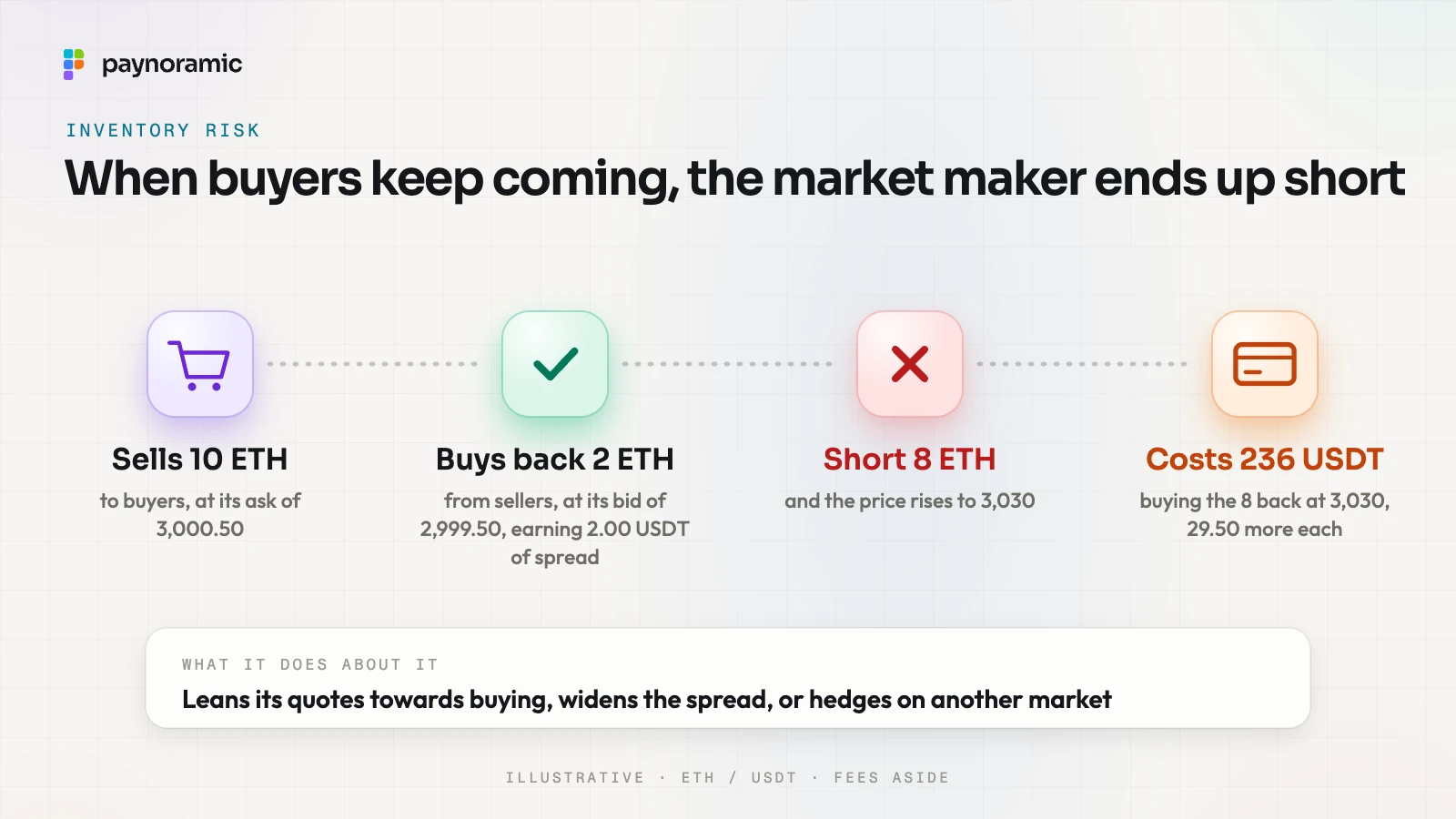
In our example, buyers take 10 ETH from its ask at 3,000.50, while sellers sell it only 2 ETH at its bid of 2,999.50. The 2 ETH it both bought and sold earned 2.00 USDT of spread, but it is now short 8 ETH. If the price rises to 3,030, buying those 8 back costs 29.50 more each than it sold them for, 236 USDT in all.
Market makers manage this in a few ways:
Leaning the quotes. Short, it raises both its bid and its ask, so it buys more and sells less until the position shrinks.
Widening the spread, which earns more per trade and slows the flow.
Hedging the position on another market.
Position limits, beyond which it stops quoting one side.
In a fast market all of these push the same way: quotes get wider and smaller, or are pulled. Liquidity can thin out exactly when traders want it most, which is why exchanges add their own controls for sharp moves; Marengo, our exchange, halts a market on a sharp price move.
Why each market maker needs its own agreement
An exchange does not simply let a market maker in. Each one comes under its own agreement with the operator, and that agreement is fitted to the operator's licence, because the licence decides who may quote at all.
In the EU, a crypto-asset service provider operating a trading platform "shall not deal on own account on the trading platform for crypto-assets they operate" (MiCA, Article 76(5)), and may engage in matched principal trading only where the client has consented (Article 76(6)), so the operator cannot be its own market maker.
In Dubai, VARA's Market Conduct Rulebook prohibits licensed firms from actively investing their own or their group's portfolio of virtual assets, with exceptions for managing their required liquid assets and their treasury (Rule VII.A). So the quotes come from separate firms.
Those firms are participants, and the platform's rules apply to them. MiCA asks for objective, non-discriminatory criteria for participation in trading (Article 76(1)(d)); VARA asks an exchange to publish and enforce a code of conduct for every participant on its venue (Exchange Services Rulebook, Rule III.A.1). The agreement sits inside those rules, and typically covers:
Markets and obligations. Which markets it quotes, the widest spread and smallest size it commits to, and for how much of the trading day.
Access. Its API keys, rate limits and how its connection is monitored.
Fees, within the platform's published fee schedule.
Conduct. MiCA prohibits orders that give "false or misleading signals" about the supply of, demand for or price of a crypto-asset (Article 91), and a platform's systems must be able to prevent or detect market abuse (Article 76(7)(g)). Quotes placed and cancelled to mislead other traders are what surveillance looks for.
Conflicts of interest. If the market maker is linked to the operator or its shareholders, that is a conflict the operator identifies, manages and discloses (Article 72).
Paynoramic holds no licence and does not operate exchanges. For a client's launch we connect the liquidity the client chooses, and its market makers trade over the API, each under the client's own agreement; the rest of a platform's obligations are in the MiCA checklist.
Frequently asked questions
Can an exchange be its own market maker? Not in the EU: MiCA bars a trading platform's operator from dealing on its own account on the platform it operates. Other regimes have their own rules, such as VARA's on a firm investing its own portfolio, and which apply is a question for the operator's counsel.
Is a market maker the same as a liquidity provider? The terms overlap. In this guide a market maker is a firm that quotes on the exchange's own order book; "liquidity provider" is also used for firms that offer prices to trade against directly, away from the book.
Why do spreads widen in a sharp move? Because a market maker's risk rises with volatility. It is more likely to be picked off and more exposed on any position it holds, so it quotes wider and smaller until the market settles.
See it working
Depth is easiest to grasp on a live book. Open Marengo at marengo.paynoramic.com, switch to Pro and watch the order book's depth bars, or read about the white-label crypto exchange to see what is handed over.