Crypto OTC trading desks: how a block trade is quoted and settled, and what a desk needs to run
A crypto OTC trading desk quotes one firm price for a block trade, holds it for seconds, books it on acceptance, hedges it on venues and settles pre-funded or net on credit, under a MiCA licence.
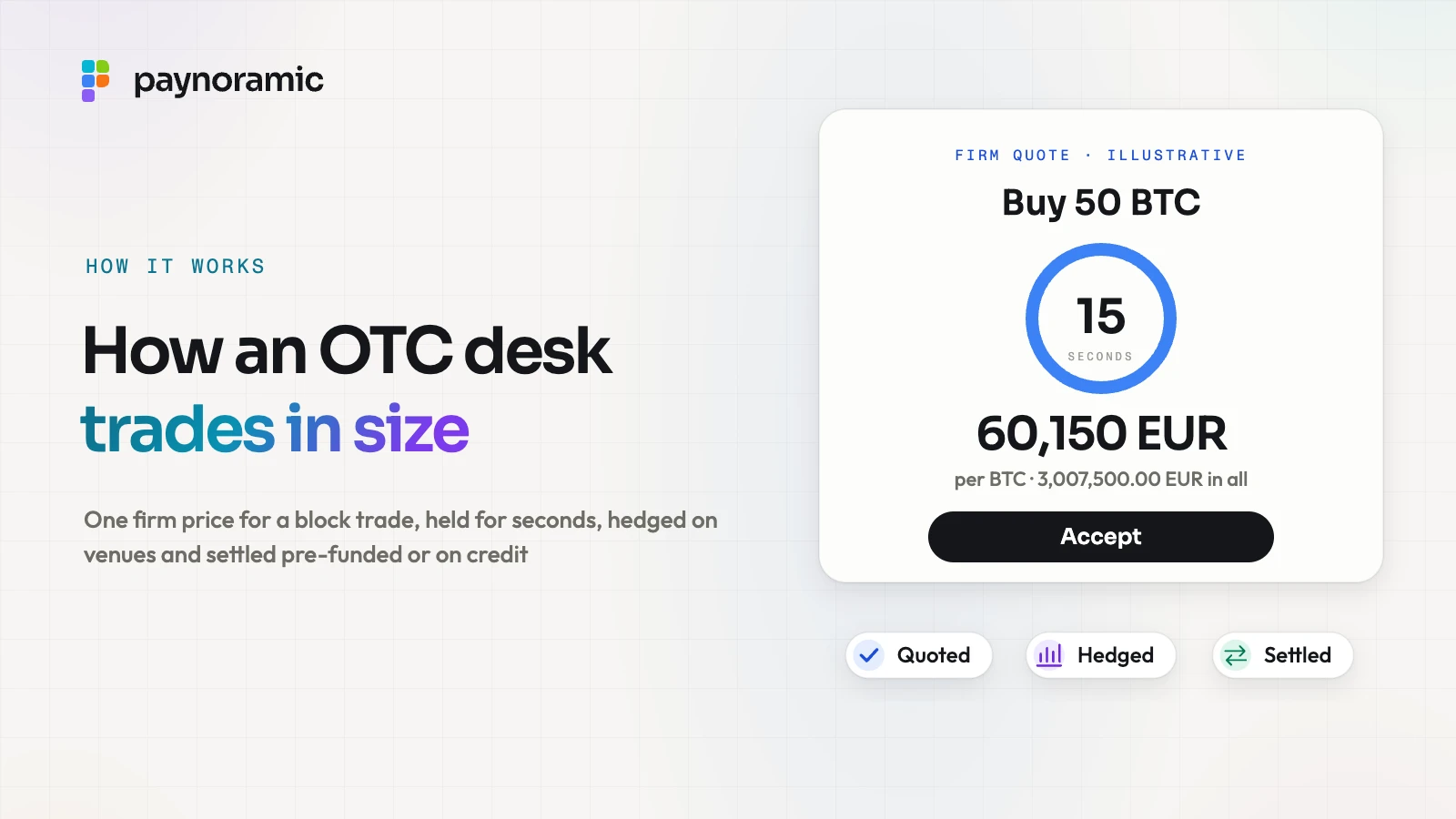
A crypto OTC trading desk trades large amounts of crypto directly with its clients instead of through a public order book. The client sends a request for quote, the desk answers with one firm price for the whole block, holds it for a few seconds, and books the trade the moment the client accepts. The desk then covers its position on trading venues and settles with the client, either from money the client sent in advance or later, on credit, in one net payment.
This guide follows one block trade through a desk, then looks at the price, the credit, the licence and the tools behind it. The guide to RFQ, liquidity and licensing maps a desk onto MiCA, VARA and the FCA in detail.
What an OTC trading desk is, and why block trades go off the book
OTC trading, over the counter, means two parties agreeing a trade between themselves. On a crypto exchange, a buyer takes whatever sits in the order book, level by level. A small order fills at the best price; a block of 50 BTC can eat through several levels, paying a worse price at each level after the first, which is slippage.
A desk removes that uncertainty. The client gets one price for the full size before it commits, nobody else sees the order, and settlement follows how institutions work: euros by bank transfer, coins to a whitelisted wallet, and for trusted clients, on credit.
Desk clients are funds, company treasuries, brokers and wealthy individuals. A retail broker screen, which quotes small amounts to many customers, is a different product built from similar parts, as the guide to broker mode explains.
The life of a block trade
Every trade follows the same steps, whether it arrives in an app, over an API or in a chat with a sales trader:
Request for quote. The client names the side, the asset and the size, and the desk checks its limits.
Quote. The desk prices the full size and answers with one firm, all-in price.
Validity window. The price holds for a stated time, often seconds; if it lapses, the client asks again.
Acceptance. Accepting inside the window fixes the trade, and the desk now carries the risk.
Booking. The ledger records two legs: what the client owes and what the desk owes.
Hedging. The desk covers its new position, or keeps it as inventory within its limits.
Settlement. The two legs change hands, pre-funded or on credit, each matched to the trade.
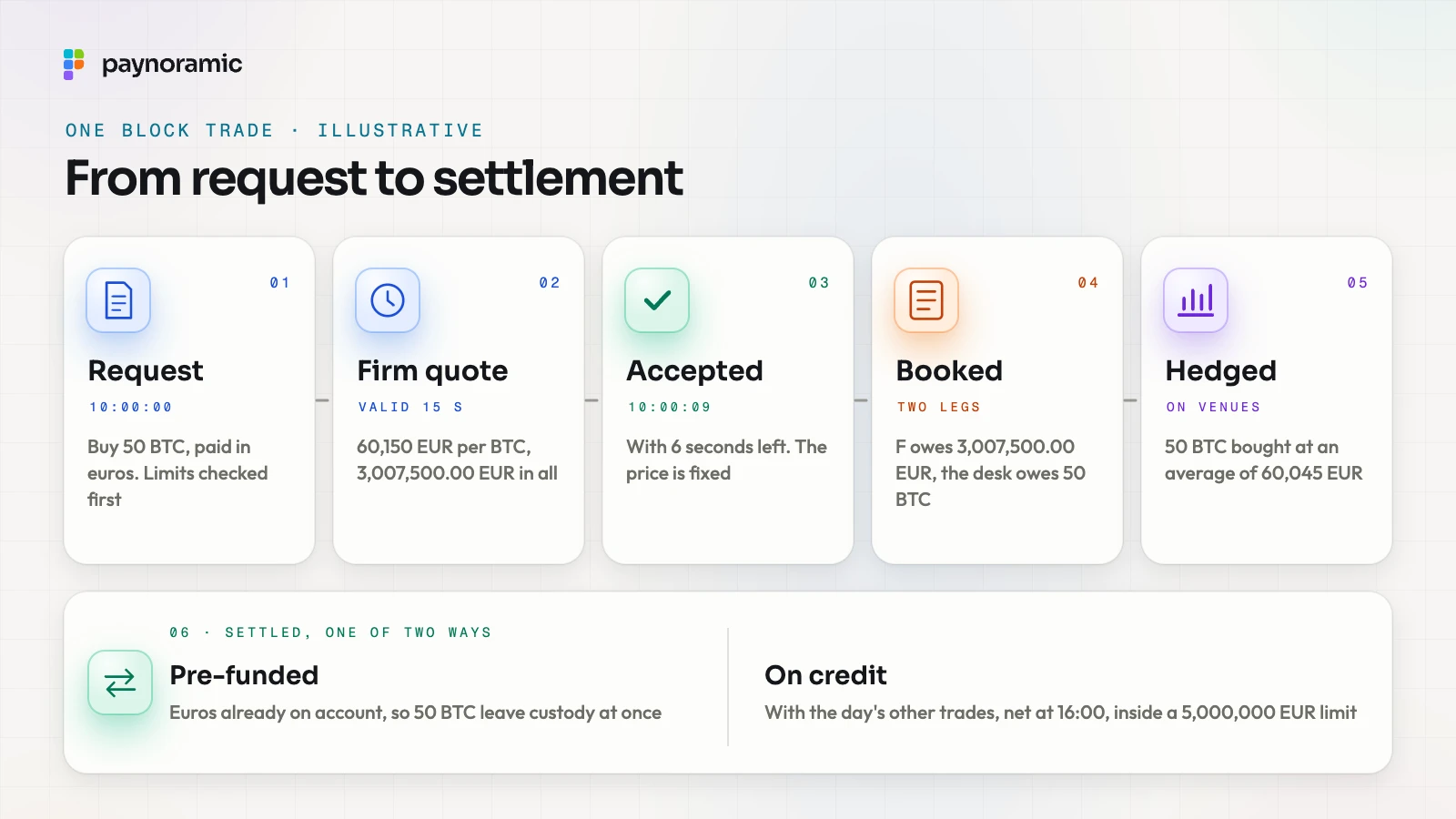
A worked example: 50 BTC for a fund
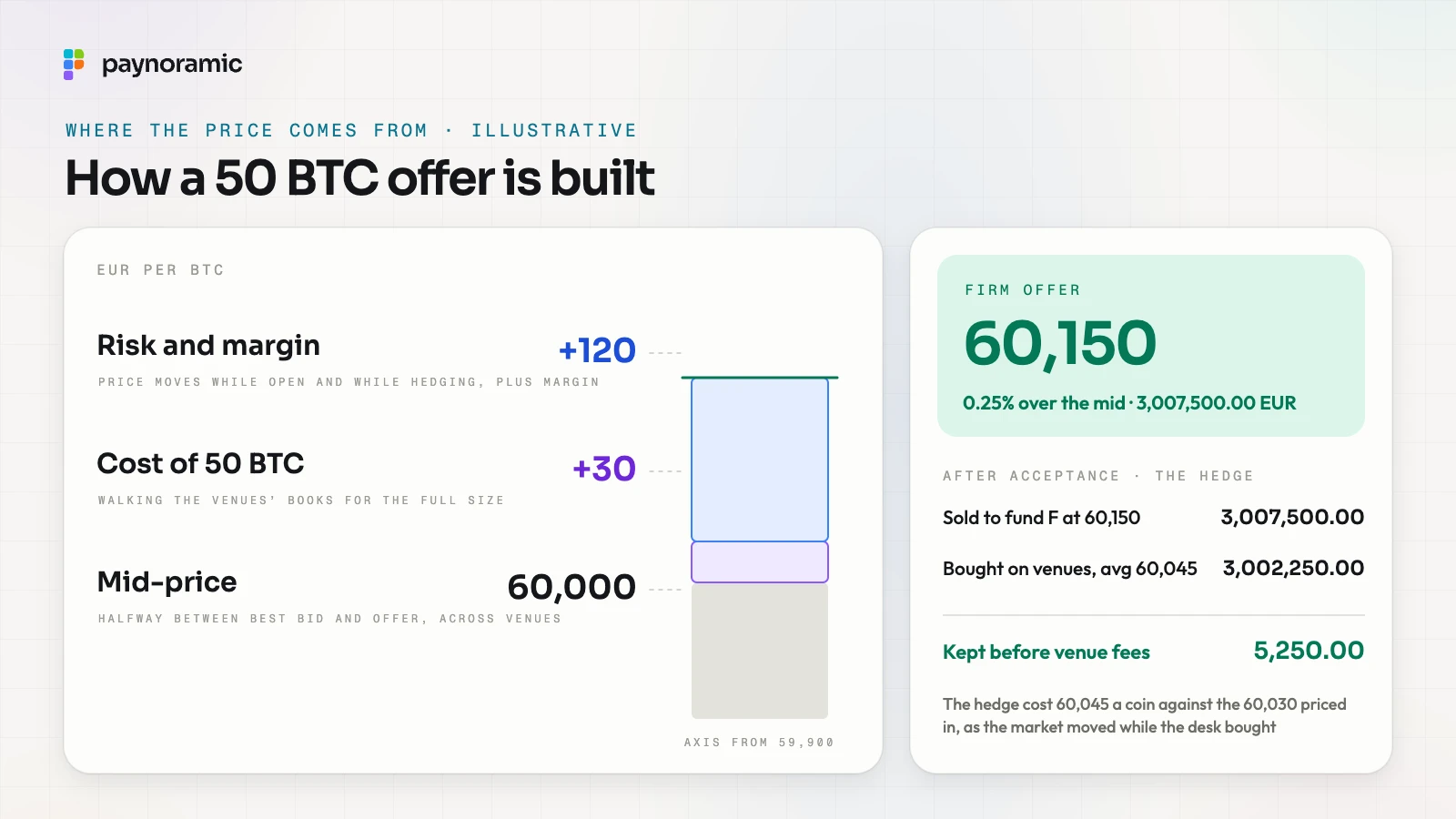
With illustrative numbers, fund F asks at 10:00:00 to buy 50 BTC against euros. The market's mid-price, halfway between the best bid and offer across the venues the desk watches, is 60,000 euros.
Buying 50 BTC would walk the venues' books, so the desk's pricing works out an average cost of 60,030 euros. It adds 120 euros for its risk and margin and quotes a firm 60,150 euros per coin, 3,007,500.00 euros in all, valid for 15 seconds.
F accepts at 10:00:09, with 6 seconds left. The trade is booked at 60,150, and the desk buys 50 BTC on its venues at an average of 60,045 euros, 3,002,250.00 in all, because the market moved slightly while it bought. The desk keeps 5,250.00 euros before the venues' fees.
Where the desk's price comes from
A desk's quote is built in layers, and the method is worth writing down, because in the EU a desk dealing on its own account must "publish a firm price of the crypto-assets or a method for determining the price" (MiCA, Article 77(2)).
The reference price. Live prices from the venues and liquidity providers the desk trades with, usually a mid-price.
The cost of the size. What the full block would cost on those venues, not just their best price; a thin market widens it.
The risk premium. The price can move while the quote is open and while the desk hedges, so a longer window or a more volatile asset costs more.
Inventory. A desk holding more bitcoin than it wants can shade its offer down, and one that is short can shade it up.
The margin. Set per asset and client tier, often in basis points.
The client sees one price, with the bid-ask spread and margin inside it: in the example, 0.25% above the mid.
After acceptance the desk can hedge at once, back to back, as in the example, sell from its own inventory, or wait for an opposite client order to net against. Each choice trades hedging cost against price risk, within the desk's limits.
Settlement: pre-funded or on credit
Pre-funded. The client sends its euros or coins before it trades. Say F had 3,100,000.00 euros on account: at acceptance the ledger takes 3,007,500.00 from its balance and credits 50 BTC, and the coins can leave custody for F's whitelisted address at once. The desk carries no credit risk, but holds client money, kept apart from its own.
On credit. A trusted client trades first and pays later, often once a day, with the day's trades netted. Say F has a settlement limit of 5,000,000 euros and settles at 16:00. At 14:30 it sells 20 BTC back to the desk at 60,400 euros, 1,208,000.00 in all. At 16:00, instead of four transfers, there are two: F pays 1,799,500.00 euros and the desk delivers 30 BTC.
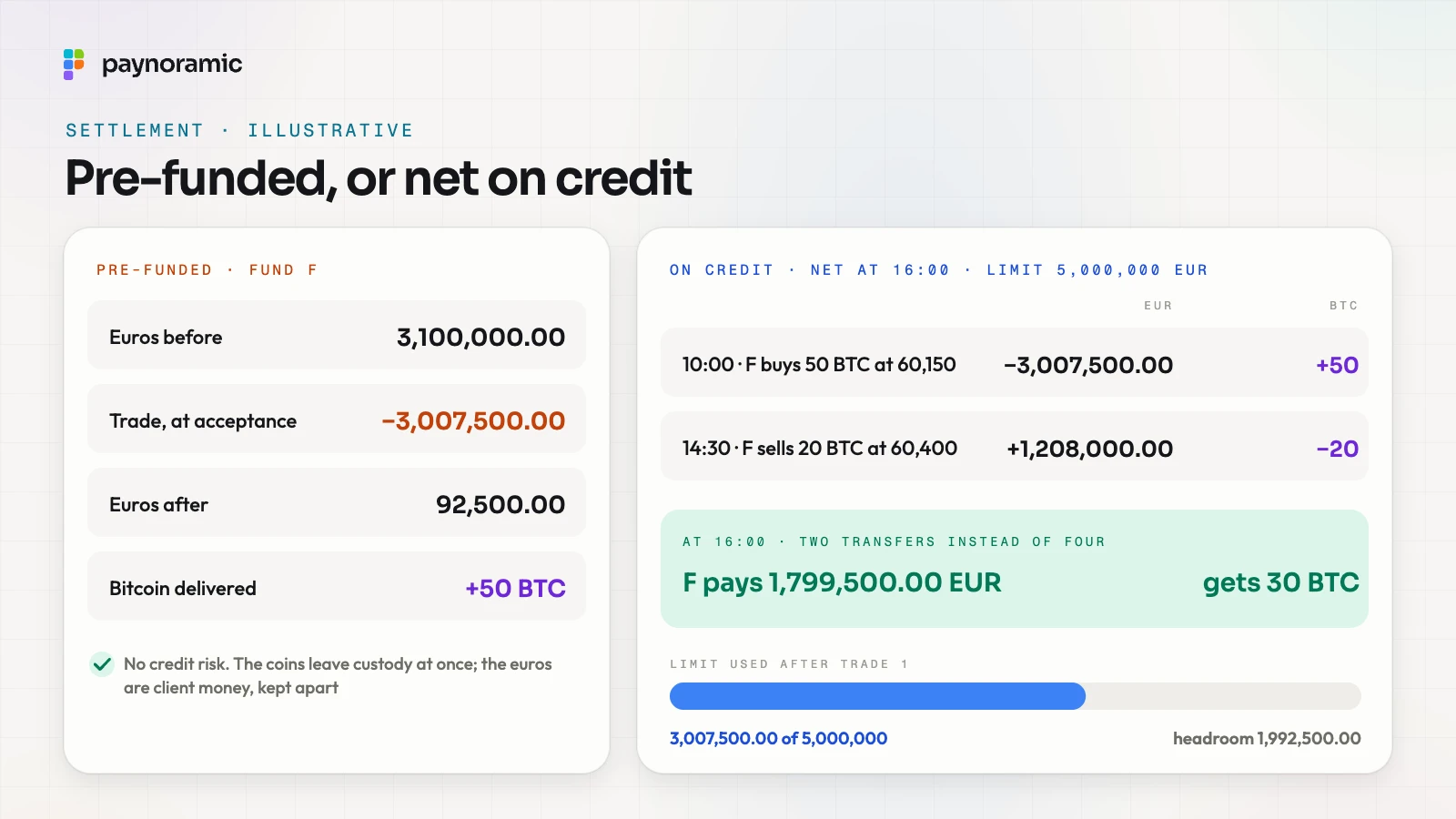
Net settlement saves fees and time, but the desk is lending: until 16:00, F owes it money.
Credit limits and counterparty risk
A credit limit caps what a client can owe before it settles, and is checked before every quote. After its first trade, F's open amount is 3,007,500.00 euros of its 5,000,000, so its headroom is 1,992,500.00. A request at 11:00 for a further 40 BTC, about 2.4 million euros, does not fit: the desk declines it or asks F to send money first.
Two different things can go wrong:
Replacement cost. If F fails before 16:00, the desk is left with the 30 BTC it bought to cover F. If bitcoin has fallen to 57,000 euros, those coins are worth 1,710,000.00 against the 1,799,500.00 F owed, a loss of 89,500.00.
Settlement risk. If the desk delivers the 30 BTC before F's euros arrive and F never pays, the loss is the whole 1,799,500.00. So who sends first is itself a credit decision, and many desks deliver only once the money is in.
Desks size limits from the client's financial strength, ask weaker names for collateral, write netting and close-out terms into the client agreement, and watch each limit's use during the day.
The licence and compliance a desk needs under MiCA
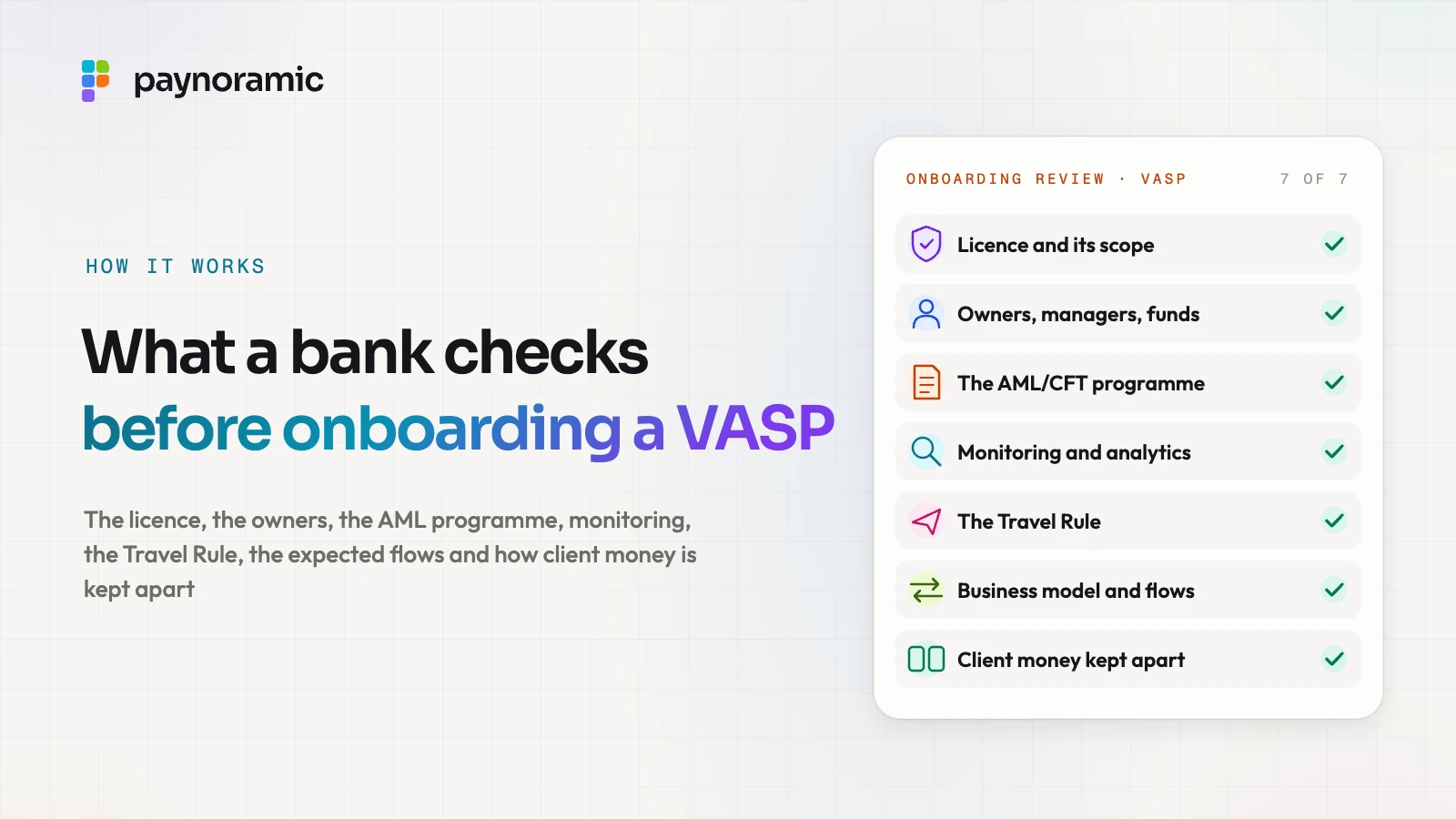
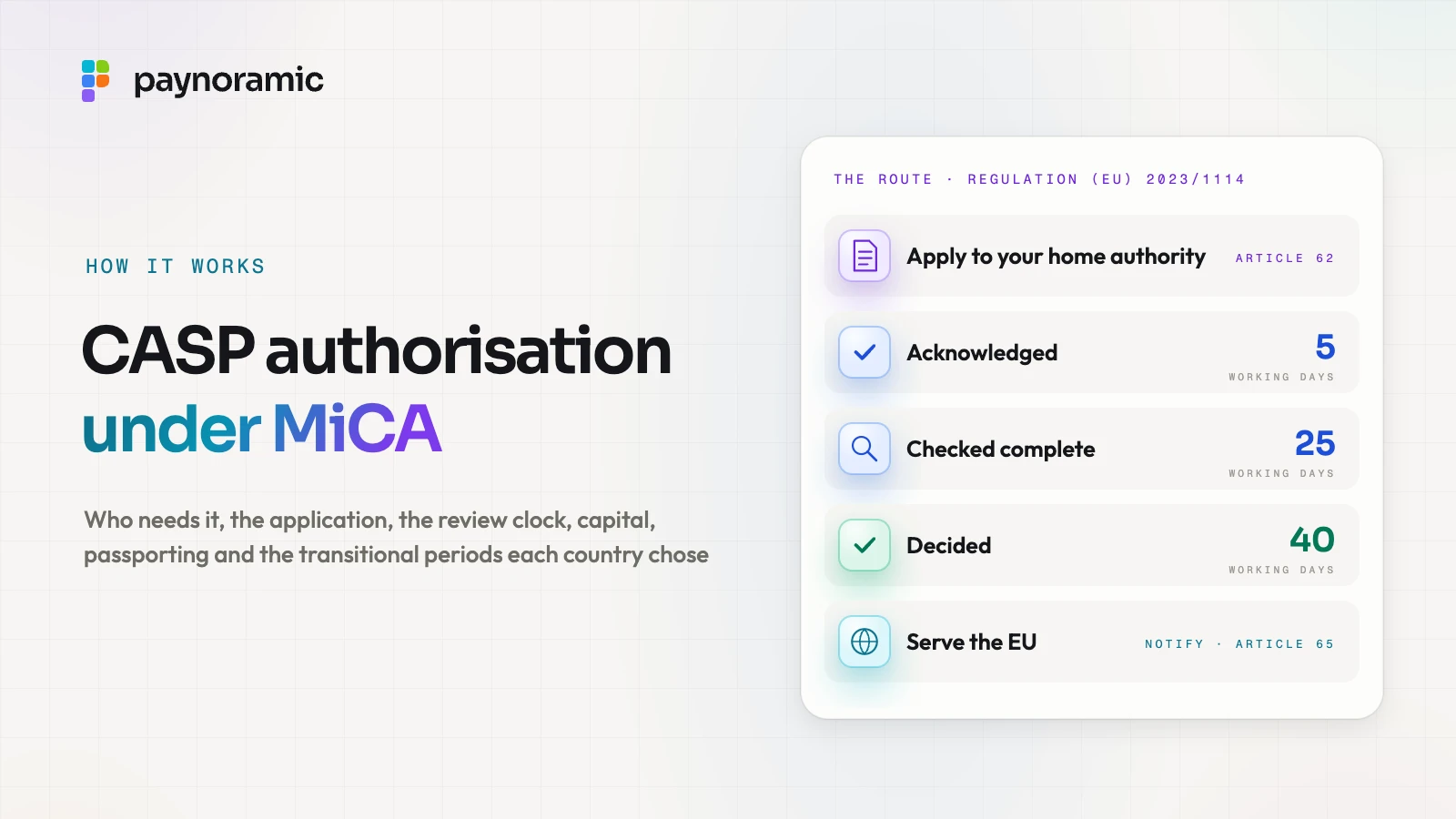
In the EU, a person "shall not provide crypto-asset services, within the Union" without authorisation (Article 59(1)). A desk trading against its own book provides the exchange of crypto-assets for funds, "by using proprietary capital" (Article 3(1), point 19), and holding clients' coins between trades adds custody. The services, capital and the rules in Dubai and the UK are in the RFQ and licensing guide. Three rules bear on the mechanics above:
Pre-funded balances are the clients'. A provider holding clients' crypto-assets must "prevent the use of clients' crypto-assets for their own account" (Article 70(1)), so a client's coins cannot double as the desk's inventory, and clients' euros go to a credit institution or a central bank by the end of the next business day (Article 70(3)).
Conflicts of interest. A principal desk is its client's counterparty and sees many clients' orders. MiCA asks for policies to "identify, prevent, manage and disclose" conflicts with and between clients, disclosed on the provider's website (Article 72), which is where the handling of a request before acceptance belongs.
Market abuse. Anyone "professionally arranging or executing transactions in crypto-assets" needs systems to prevent and detect market abuse and must report suspicions (Article 92(1)), its own hedging included, as the market abuse guide explains.
A CASP is also an obliged entity under the EU's anti-money-laundering directive (Regulation (EU) 2023/1113, Article 38). For a corporate client, due diligence means identifying the beneficial owner and taking "reasonable measures to understand the ownership and control structure of the customer", and checking that anyone acting for it "is so authorised" (Directive (EU) 2015/849, Article 13(1)). On a desk that is KYB for the fund, then identity checks for its directors, owners and each trader allowed to accept a quote.
Every crypto delivery then carries Travel Rule data: the desk, as the originator's provider, sends the originator's name, distributed ledger address and either an address with an identity document number or a date and place of birth, plus the beneficiary's name and distributed ledger address (Regulation (EU) 2023/1113, Article 14), applied since 30 December 2024. This is general information, not legal advice.
The tools a desk runs on
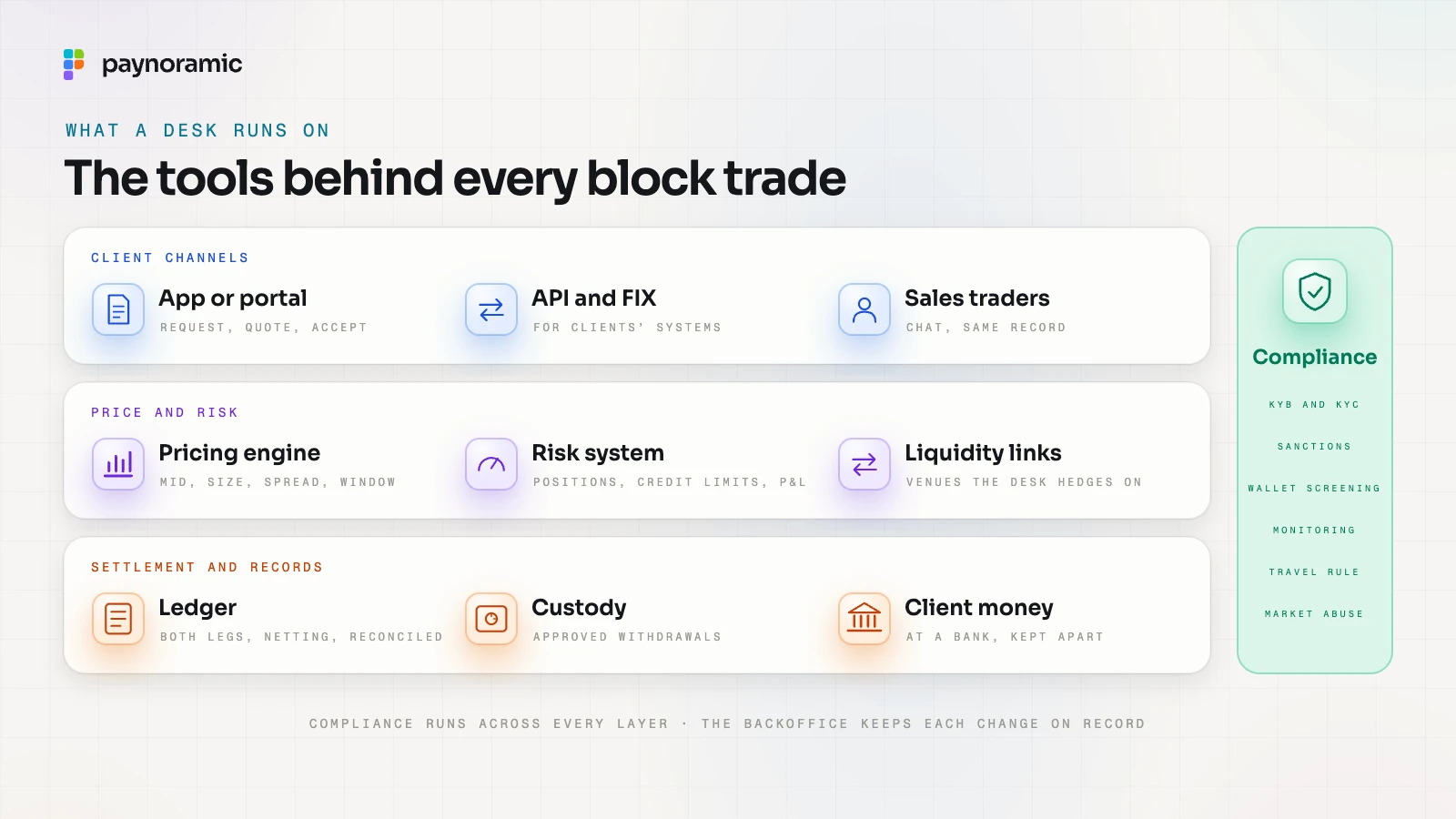
Tool | What it does on the desk |
|---|---|
Client channels | App or portal, API or FIX, chat with sales traders, all reaching one record |
Pricing engine | Live prices, cost of size, spread and margin rules, validity window |
Liquidity connections | Links to the venues and providers the desk hedges with |
Risk system | Positions, inventory limits, credit limits and their use, profit and loss |
Ledger | Both legs of every trade, client balances, net settlement, reconciliation |
Custody and payments | Approved withdrawals to whitelisted addresses; client money at a bank |
Compliance | KYB and KYC, sanctions and wallet screening, monitoring, Travel Rule, market-abuse surveillance |
Backoffice | Confirmations, statements, limits and settings, each change on record |
API clients often connect over FIX, as the FIX guide explains. Many firms run a desk beside a retail venue. You can see one piece of that in Marengo, our white-label crypto exchange: its broker mode gives customers firm quotes from the operator's own inventory.
Frequently asked questions
How is OTC crypto trading different from trading on an exchange? On an exchange, the client's order meets other orders in a public book and fills at whatever prices are there. On an OTC desk, the client gets one firm price for the full size from the desk itself, and the trade is settled between the two of them.
How long is an OTC quote valid? As long as the desk says, often a few seconds for a liquid asset. MiCA asks a desk dealing on its own account to tell clients when an order is final and to execute at the price displayed at that moment (Article 77(3)).
Why would a client trade on credit instead of pre-funding? Pre-funding ties up its money at every desk it uses. Credit lets it trade at once and settle the day in one net payment, within a limit.
See it working
An OTC desk is proven parts arranged around one flow. Our white-label crypto OTC desk is assembled from modules already in production, with the request-for-quote flow built on them for each desk and credit limits and deferred settlement as part of a custom build. To see firm quotes from an operator's inventory working today, open Marengo at marengo.paynoramic.com.