Hot wallets, cold wallets and custodians: where an exchange keeps your crypto
An exchange records who owns what in its ledger and keeps the coins in wallets: a small float in online hot wallets for withdrawals, most in offline cold wallets, checked against the ledger daily.
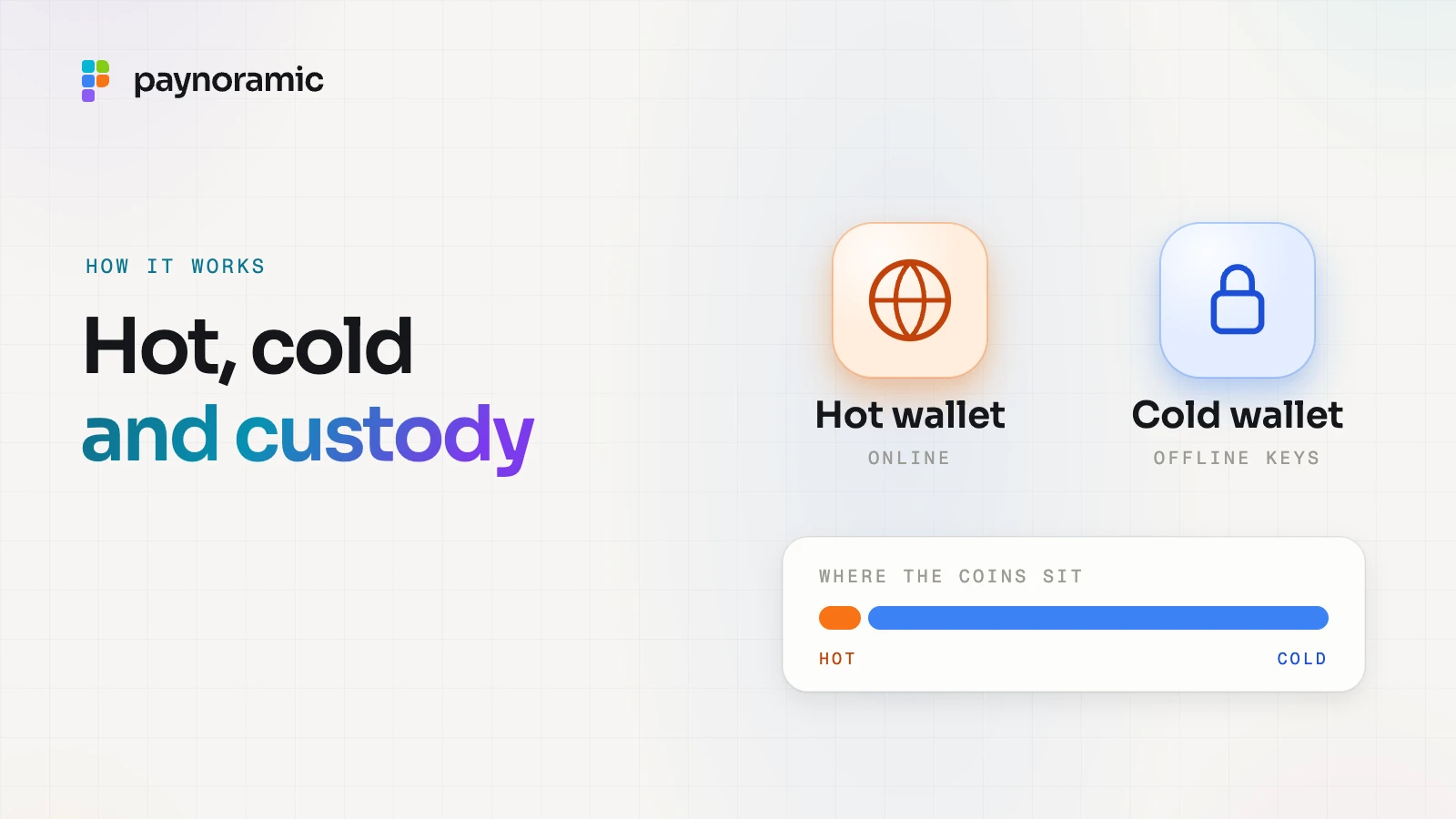
When a customer buys Bitcoin on an exchange, nothing arrives in a vault with their name on it. The exchange writes a line in its ledger saying what the customer owns, and the coins themselves sit in wallets that the exchange or its custodian controls. Most of them are in cold wallets, whose keys stay offline, and a small working float is in hot wallets that pay out withdrawals. This guide explains how the two fit together, how coins move between them, and how an operator proves every coin is where the ledger says.
Two records: the ledger and the wallets
An exchange keeps two separate records of the same coins.
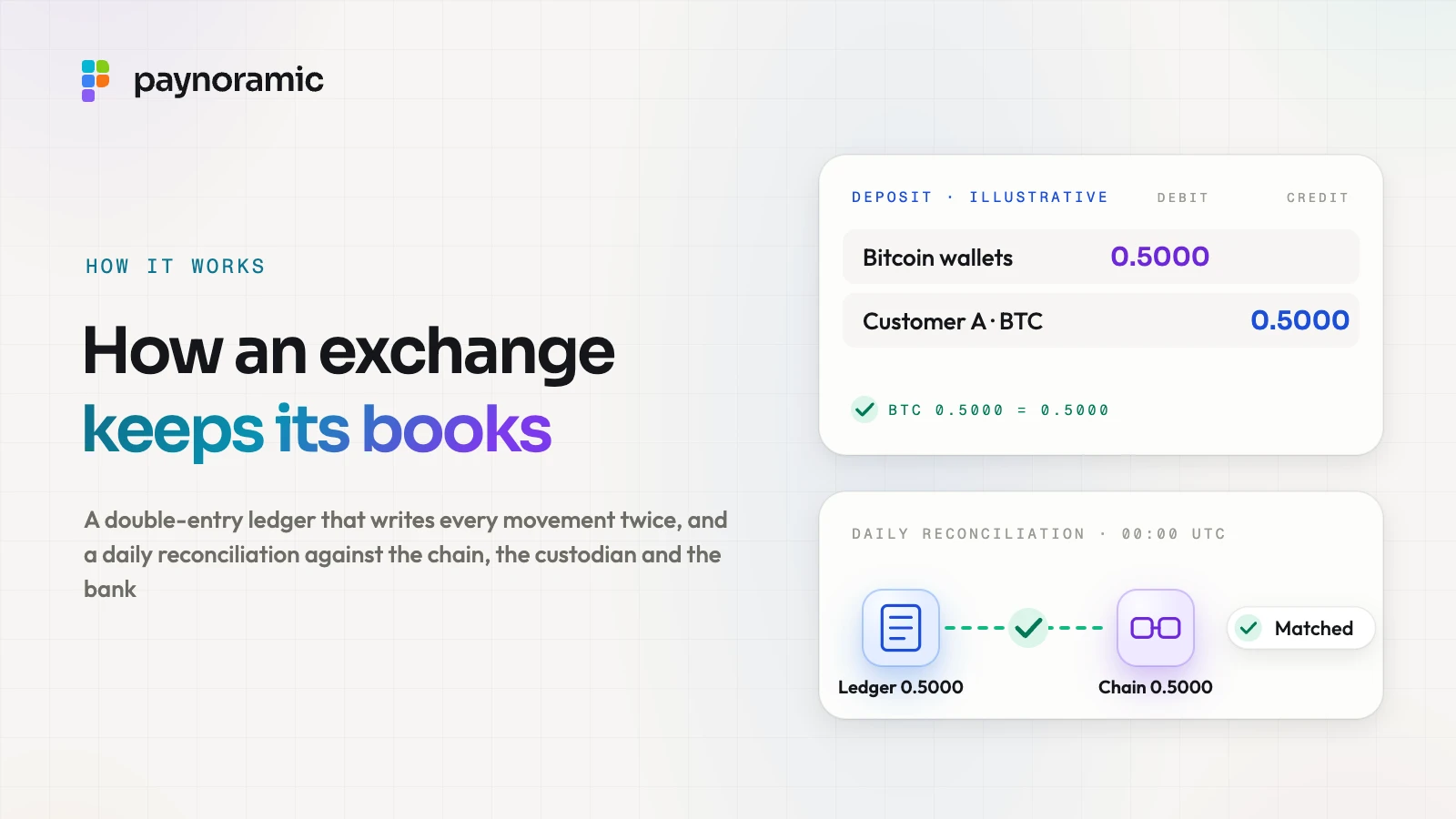
The ledger says who owns what. It is the exchange's own database, usually a double-entry ledger, where every trade, fee, deposit and withdrawal is a pair of entries that balance per asset.
The wallets say where the coins are. They are addresses on each blockchain, controlled by private keys that the exchange or its custodian holds.
The two are deliberately different shapes. The ledger has an account per customer; the wallets usually pool all customers' coins of one asset into a few addresses, often called omnibus wallets. A trade between two customers changes the ledger only: no coin moves on chain, because both sides stay in the same pool.
You can see this in Marengo, our exchange: each fill lands on a double-entry ledger that balances per asset, and a reconciliation checks every account.
Hot wallets: online, quick, small
A hot wallet is one whose keys can sign transactions without a person carrying anything offline. It is connected to the exchange's systems, so when a customer asks to withdraw, the payout can be signed and broadcast in minutes.
Being online is also the risk: it is the part of the exchange an attacker can reach, so it holds only a small share of the coins, sized to cover the withdrawals expected over the next few hours or a day.
Deposits come in through the same online systems. Each customer gets a deposit address of their own, the ledger credits them once the deposit has enough confirmations, and the coins are later swept into the exchange's main wallets.
Cold wallets: offline, slow, most of the coins
A cold wallet is one whose keys never touch the internet. They are generated and kept on offline hardware, sometimes in several locations, and a transaction is signed there and carried out to be broadcast.
Most of the coins live in cold storage, because there is nothing online to break into. The price is time: signing takes people, devices and a procedure, so cold wallets are not used for everyday withdrawals.
Some operators add a warm tier in between, with keys online but behind stricter rules and larger approvals. The principle stays the same: the more a wallet holds, the harder it is to move from.
Hot wallet | Cold wallet | |
|---|---|---|
Keys | Online, signing automatically within rules | Offline, signing by hand |
Holds | A small working float | Most of the coins |
Speed | Minutes | Hours, by design |
Used for | Customer withdrawals | Reserves and top-ups of the hot wallet |
Main risk | Remote attack | Loss of keys, insider collusion |
Moving funds from cold to hot
When withdrawals drain the hot wallet, it is topped up from cold. That transfer is the most sensitive routine operation an exchange runs, so it takes several approvals by design. A typical flow:
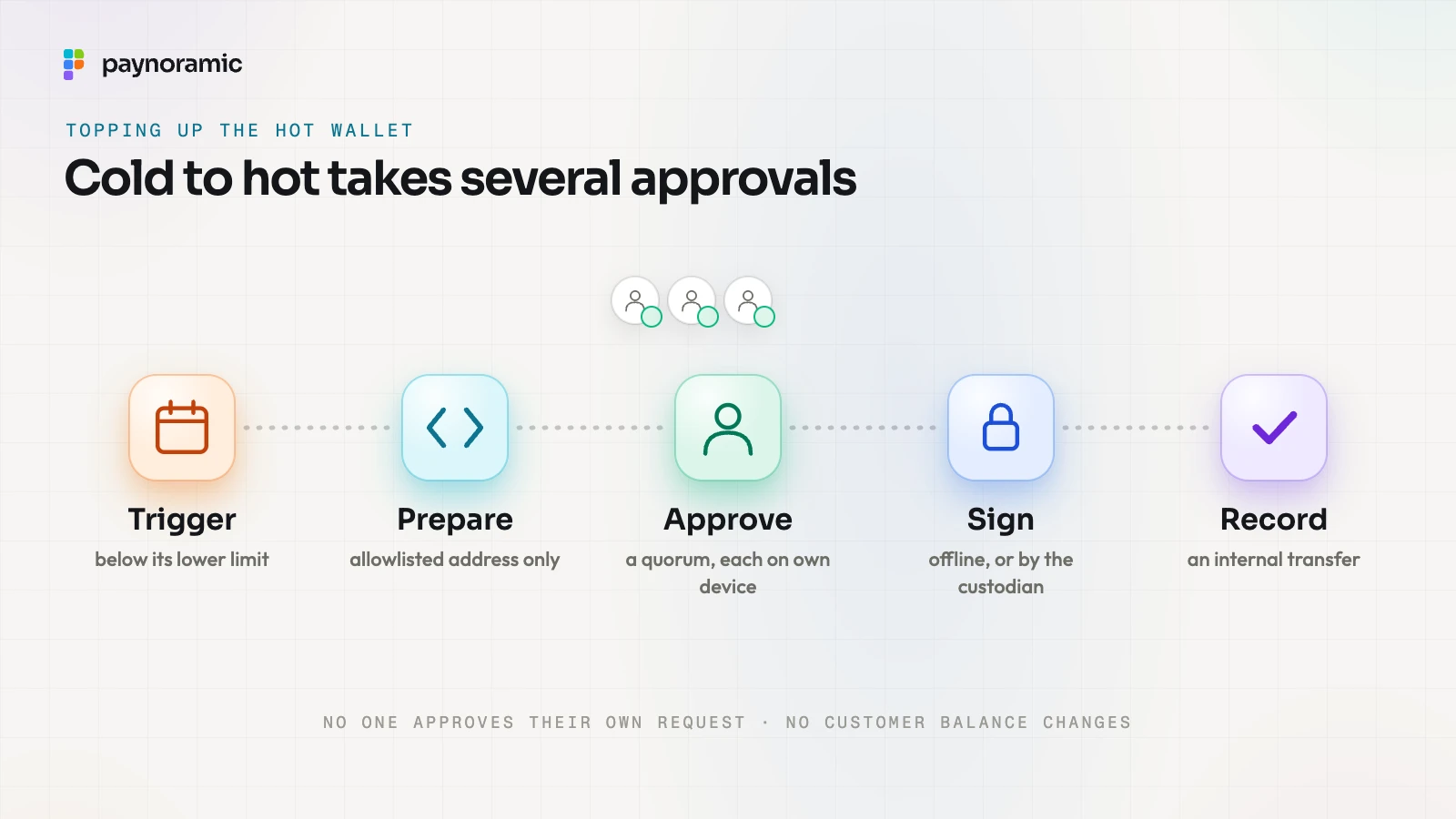
A trigger. The hot wallet falls below its lower limit, and the system raises a top-up request for a set amount.
Preparation. An operator prepares the transaction. The destination can only be one of the exchange's own hot wallet addresses, from a fixed allowlist.
Approval. Several people approve it, each on their own device, until the required quorum is reached. Nobody approves their own request.
Signing. The transaction is signed in the offline environment, or by the custodian's cold signing process, and broadcast.
Recording. Once it arrives, the ledger records an internal transfer between the exchange's own wallets. No customer balance changes.
The reverse runs too. When the hot wallet rises above its upper limit, the surplus is swept back to cold, so the float stays small.
Splitting the keys so no one person can move funds
A single key held by a single person is a single point of failure: one theft, one mistake or one bad actor. Exchanges split control so that a transaction needs several parties, in one of two main ways.
Multisig. The wallet itself, on chain, requires a set number of signatures from a larger set of keys, for example two of three. The rule is visible on the blockchain, and each chain supports it in its own way.
MPC (multi-party computation). The key is never whole anywhere. Several parties hold shares and compute a signature together, which the chain sees as an ordinary single signature, so the same approach works across chains.
Either way, a policy sets who may approve what, up to which amount and to which addresses: the technology enforces the quorum, the policy decides who is in it.
Reconciliation: the ledger against the wallets
The ledger and the wallets have to agree, coin for coin, per asset. Reconciliation is the check that they do, usually run automatically at least once a day and often more.
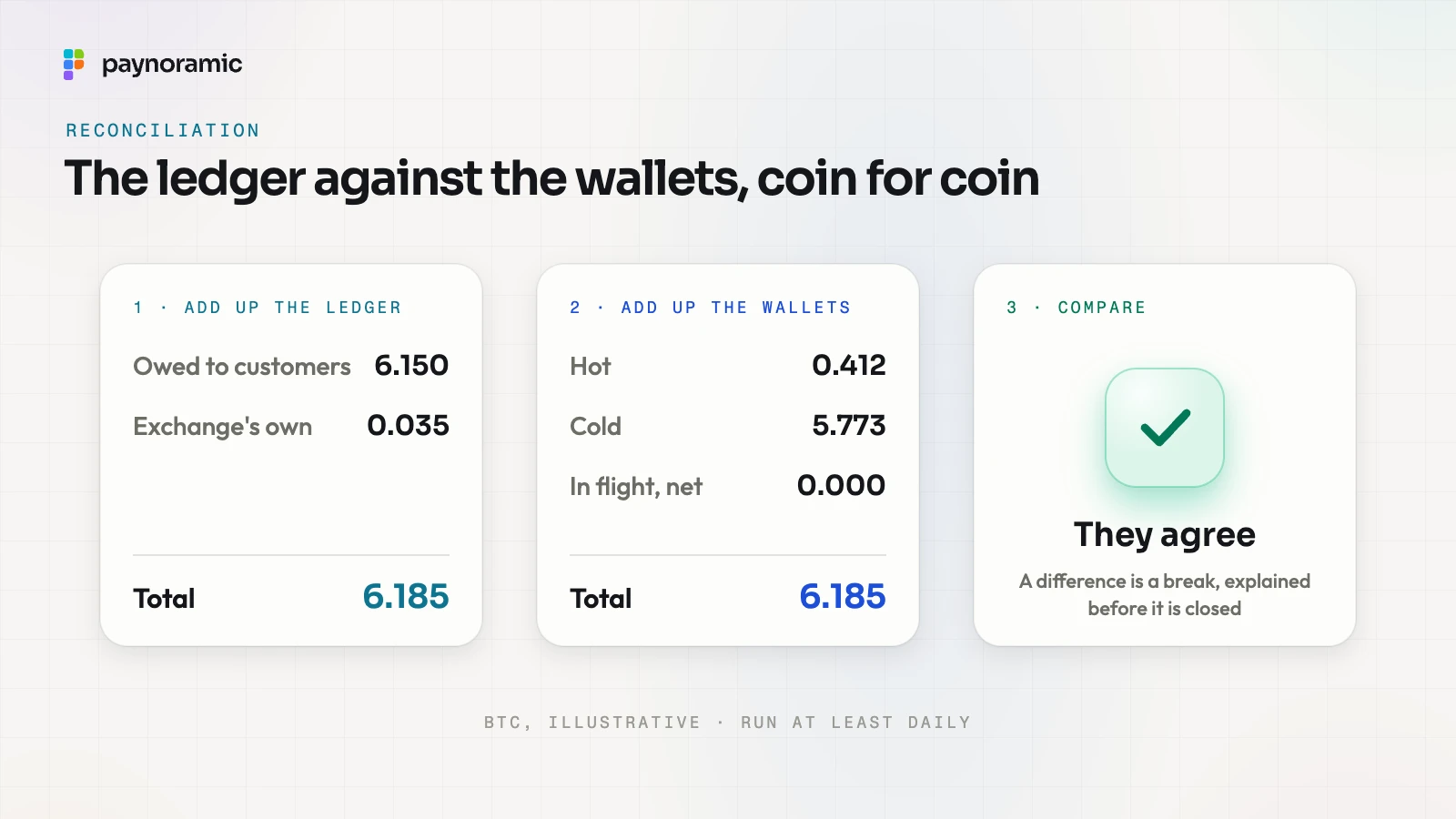
It works in three steps:
Add up the ledger. The total owed to customers in each asset, plus the exchange's own balance in it.
Add up the wallets. The on-chain balance of every hot, warm and cold address in that asset, adjusted for what is in flight: deposits not yet credited, withdrawals sent but not confirmed.
Compare. Any difference is a break, and each one is explained before it is closed.
Breaks have ordinary causes: a network fee paid on chain but not booked, a stuck withdrawal, a small unsolicited deposit. A break that cannot be explained is the early warning that something is wrong, which is why the check runs daily rather than at the year's end.
Proof of reserves, briefly
Proof of reserves is a way of showing outsiders what reconciliation shows the operator. The exchange demonstrates that it controls wallets holding at least what it owes, often with a cryptographic list of customer balances in which each customer can check that their own is included.
It has limits: it is a snapshot at one moment, and it shows assets more convincingly than it shows that every liability was counted. It complements an audit and a sound custody setup rather than replacing them.
A licensed custodian or custody run in-house
Who holds the keys is a business decision as much as a technical one. A custodian is a separate firm whose service is holding keys for others.
With a custodian, the exchange's wallet service connects to the custodian's platform. Keys, signing and much of the approval policy sit with the custodian, and the exchange keeps the ledger and decides what to request.
In-house, the operator runs its own hardware security modules or MPC cluster, its own key ceremonies and its own approvers. It keeps full control and carries the whole operational burden.
Many operators mix the two, for instance a hot wallet on their own MPC setup and cold storage with a custodian. In each case the withdrawal side works the same way: requests pass the operator's approval rules and limits before they reach a signer. You can see this in Marengo, our exchange, where withdrawals pass approval rules and daily limits set by verification level.
Paynoramic holds no licence and does not operate exchanges. In the exchange software we build and hand over, the custody and wallets connect to the client's custodian, or to the client's own HSMs or MPC cluster, so the keys sit with the licensed operator or the custodian it appoints.
What MiCA asks of custody in the EU
The EU's Markets in Crypto-Assets Regulation sets out how a crypto-asset service provider that holds clients' crypto has to treat it (Regulation (EU) 2023/1114). The main points of its custody article:
Segregation. Clients' holdings are segregated from the provider's own, and "on the distributed ledger" clients' crypto-assets are held separately from the provider's. They are legally segregated so that the provider's creditors have no recourse to them, in particular in insolvency (Article 75(7)).
A custody policy. The provider establishes a custody policy with internal rules and procedures, which minimises the risk of loss "due to fraud, cyber threats or negligence"; clients can ask for a summary in electronic form (Article 75(3)).
A register of positions. The provider keeps a register opened in each client's name and gives clients a statement of their positions at least once every three months (Article 75(2) and (5)).
Liability and delegation. The provider is liable for losses from incidents attributable to it, capped at the market value of the lost crypto-asset at the time of the loss, and may only use other custody providers authorised under MiCA, telling clients when it does (Article 75(8) and (9)).
More generally, providers that hold clients' crypto-assets make adequate arrangements to safeguard clients' ownership rights, especially in insolvency, and to prevent their use for the provider's own account (Article 70(1)). In practice the segregation rule shapes the wallets: the omnibus wallets hold only clients' coins, and the exchange's own coins sit elsewhere. The rest of a provider's obligations are in the MiCA checklist.
Frequently asked questions
Are a customer's coins held at an address in their name? Usually not. Coins are pooled in the exchange's wallets, and the ledger records each customer's share. A customer who wants coins at an address only they control withdraws to their own wallet, the difference set out in centralised and decentralised exchanges compared.
Does proof of reserves show that an exchange is solvent? Not on its own. It shows that certain wallets held certain coins at one moment, and how far it proves liabilities depends on how the balance list was built.
Who holds the keys with Paynoramic's exchange software? The licensed operator, or a custodian it appoints. Paynoramic builds and hands over the software; it holds no client funds and no keys.
See it working
The split between ledger and wallets is easiest to grasp by watching a trade go through. Open Marengo at marengo.paynoramic.com to see a ledger that balances to the asset, or read about the white-label crypto exchange to see what is handed over.