How a crypto deposit is credited: from the blockchain to the balance
An exchange credits a crypto deposit when a payment reaches an address it gave that user, on a network it watches, and has enough confirmations. Then one ledger entry turns it into a balance.
A crypto deposit is credited when the exchange sees a payment to an address it gave that customer, on a network it watches, and the payment has collected enough confirmations to be trusted. At that point the exchange writes one entry in its ledger, and that entry, not the coins on the chain, is what the customer sees as a balance. Along the way the deposit can be screened, and two common mistakes, the wrong network and a missing memo, can stop it from being matched at all. This guide follows a deposit from the block to the balance.
A deposit address for each user and each network
On most blockchains, the exchange gives every customer a deposit address of their own. The reason is matching: a blockchain payment carries no name and no reference field, so the only reliable way to know who paid is the address the coins arrived at. If an address belongs to one customer, any payment to it can only be theirs.
The address is also per network. Each blockchain has its own addresses and its own copy of a token, so a customer who deposits USDT on two networks gets two addresses. The exchange keeps a table that maps every address to a customer, a network and the assets it accepts. What each part of an address means, and why the network matters when sending, is covered in how a crypto withdrawal reaches the right wallet.
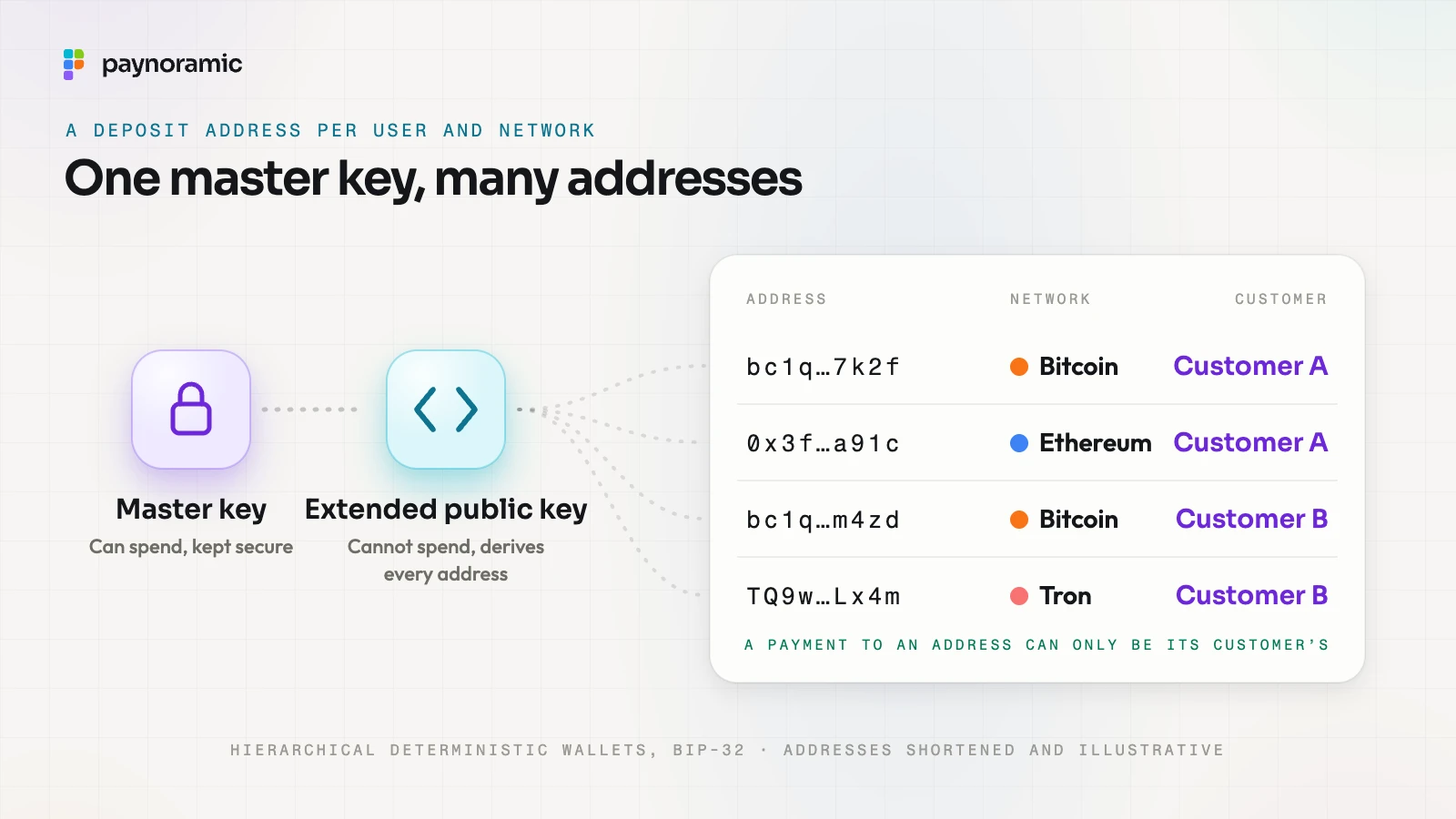
Handing out thousands of addresses does not mean storing thousands of unrelated keys. Hierarchical deterministic wallets, defined in BIP-32, derive any number of addresses from one master key. The standard notes that this lets a business's web server "generate fresh addresses" while holding only an extended public key, so the server that hands out addresses never holds a key that can spend. In practice the addresses often come from the exchange's custodian, through the custody and wallets module, by the same principle.
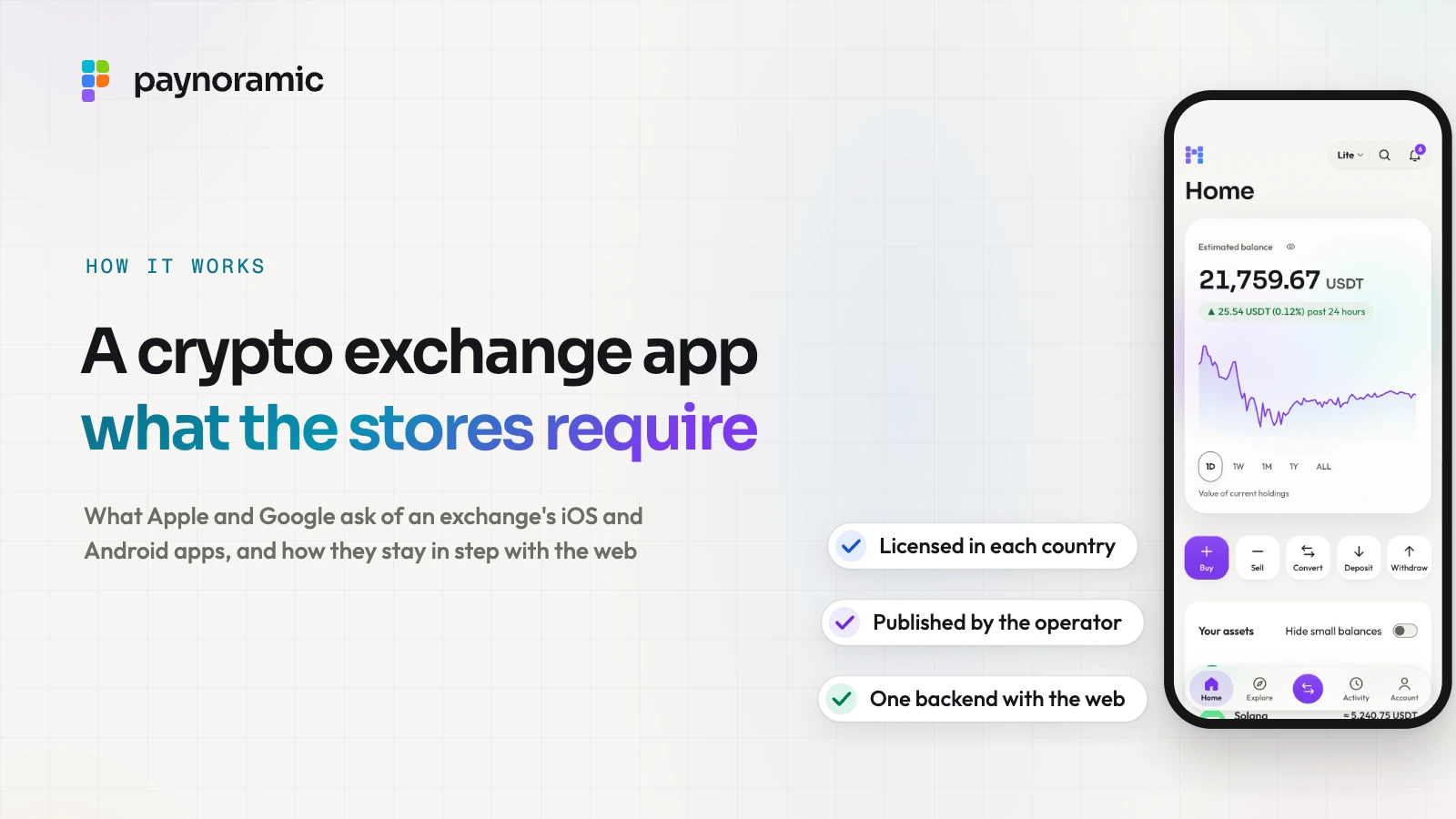
You can see this in Marengo, our exchange, where Deposit sits beside Buy, Sell, Convert and Withdraw on the home screen.
What the exchange watches on the chain
The exchange runs nodes for each network it supports, or reads them through a node provider, and examines every new block for payments to any of its addresses. What counts as a payment depends on the chain:
Bitcoin and similar chains. A transaction has outputs, each paying an amount to an address. The exchange looks for outputs that pay one of its deposit addresses.
Native coins on Ethereum. A transaction carries a value in ether to an address, and the exchange matches the recipient.
Tokens on Ethereum. A token balance lives inside the token's own contract, so no coin moves to the address as such. The token standard EIP-20 says its Transfer event "MUST trigger when tokens are transferred", and the exchange reads those events.
That last point carries a trap. Anyone can deploy a contract called USDT that emits Transfer events, so the exchange recognises a token by its contract address, never by its name, and ignores everything it has not listed.
When a match appears, the exchange records the deposit as seen but not credited: the transaction's hash, which output or event it was, the amount, the address and the block. The hash and the position together identify the deposit uniquely, so the same payment can never be credited twice, even if the exchange reads the block again.
Confirmations before crediting
A payment in a block is not yet final. Two miners can find blocks at nearly the same moment, and the chain the network keeps can drop one of them in a reorganisation. A deposit in a dropped block may come back in a later one, or not at all if the sender spent the same coins elsewhere.
Each block added on top makes that less likely. So the exchange waits for a set number of confirmations, counting the block that holds the payment as the first, and shows the customer the count as it rises.
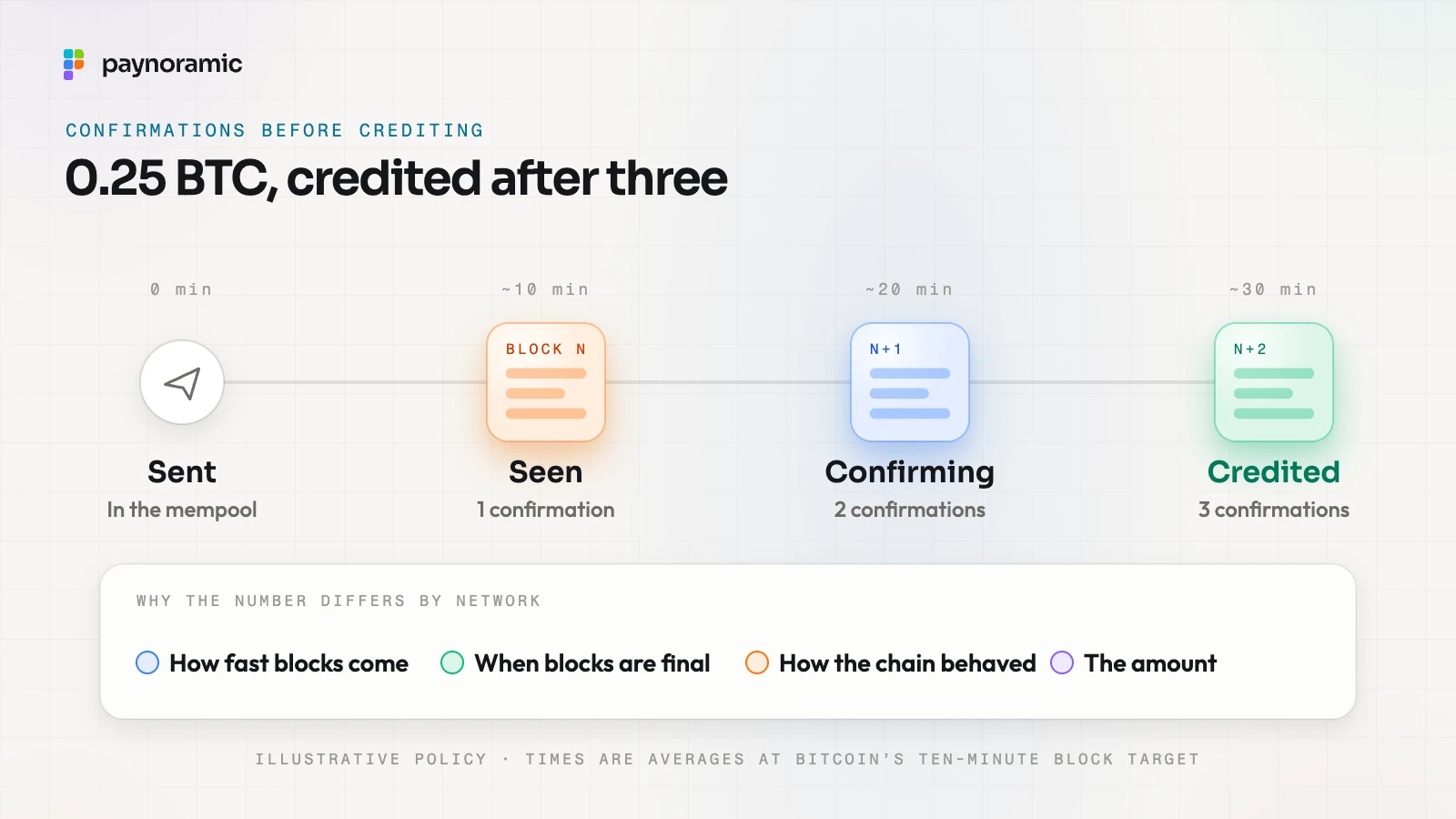
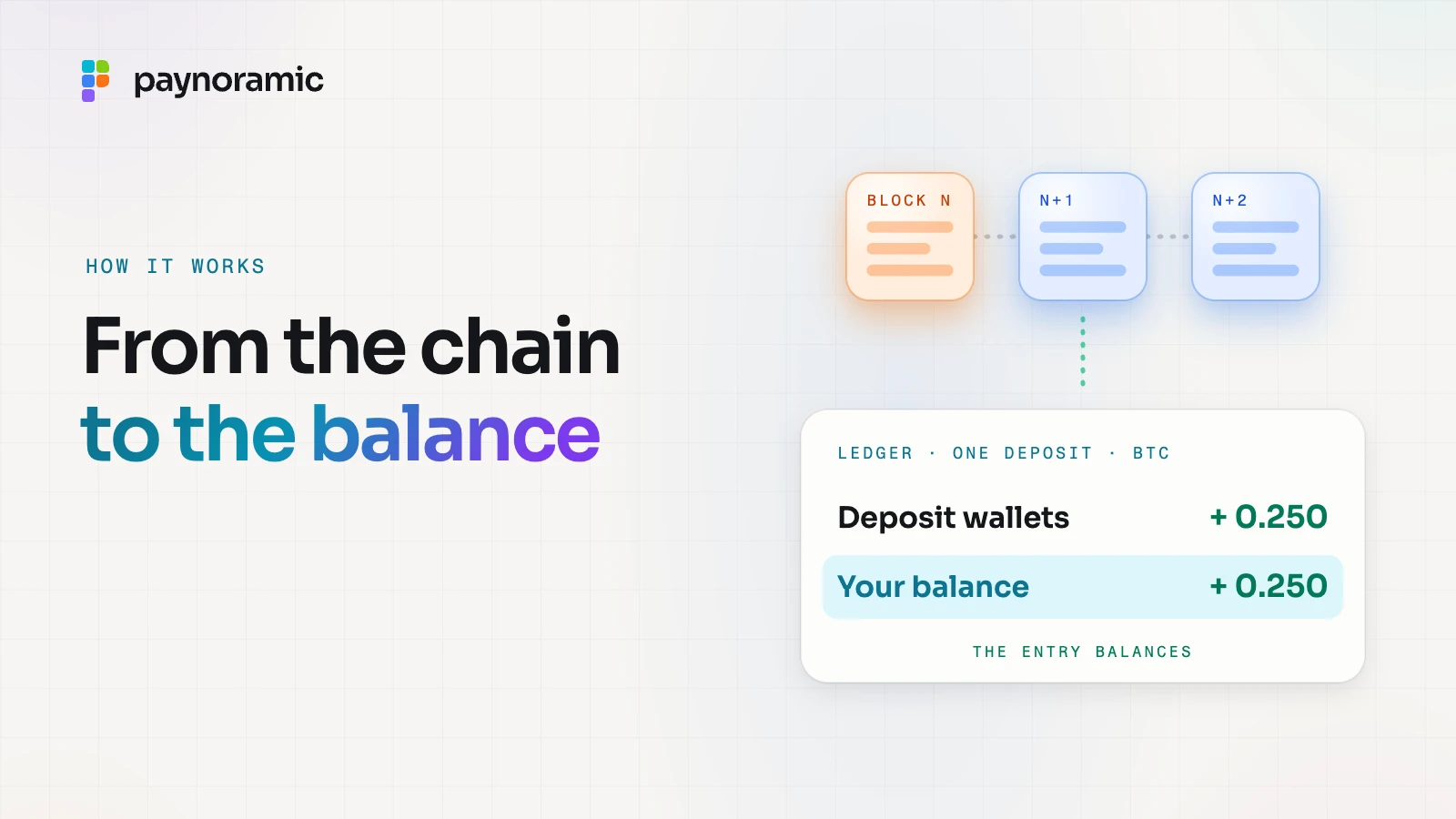
Take an example, with an illustrative policy of three confirmations for Bitcoin. A customer sends 0.25 BTC. The exchange sees it in block N, counts N+1 and N+2, and credits it once the third confirmation is in. Bitcoin produces a block about every ten minutes on average, so that is roughly half an hour, more or less depending on luck.
Why the number differs by network
Each network gets its own number, chosen by the exchange, because the risk behind a confirmation differs:
How fast blocks come. A chain that adds a block every few seconds gives many more confirmations in the same time, so its count is higher for the same wait.
How finality works. On proof-of-work chains a payment only grows harder to undo. Some proof-of-stake chains, Ethereum among them, mark blocks as finalised after a set point, and an exchange can wait for that instead of a count.
How the chain has behaved. A smaller chain that is cheaper to attack, or one that has had deep reorganisations, earns a longer wait.
The amount. Some exchanges wait longer for large deposits.
Some exchanges also use two thresholds: the deposit becomes tradable after a few confirmations, and withdrawable only after more.
The ledger entry that makes the balance
Nothing on the chain says what a customer owns on an exchange. The coins sit at the exchange's address, and the customer's balance is a figure in the exchange's own double-entry ledger, the sum of every entry on their account.
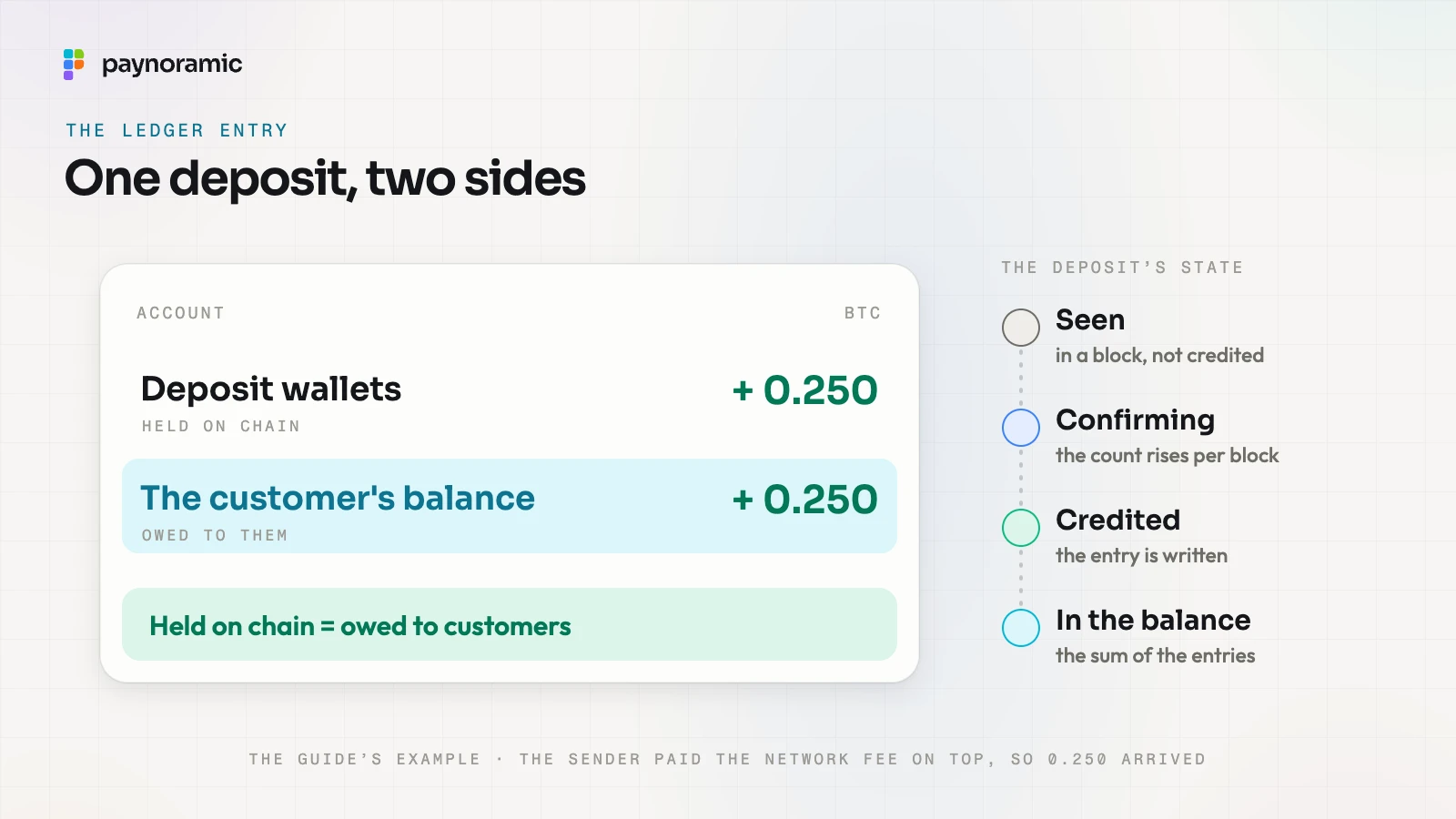
Crediting the deposit is one entry with two sides. For the example:
Account | BTC |
|---|---|
Deposit wallets, held on chain | + 0.250 |
The customer's balance, owed to them | + 0.250 |
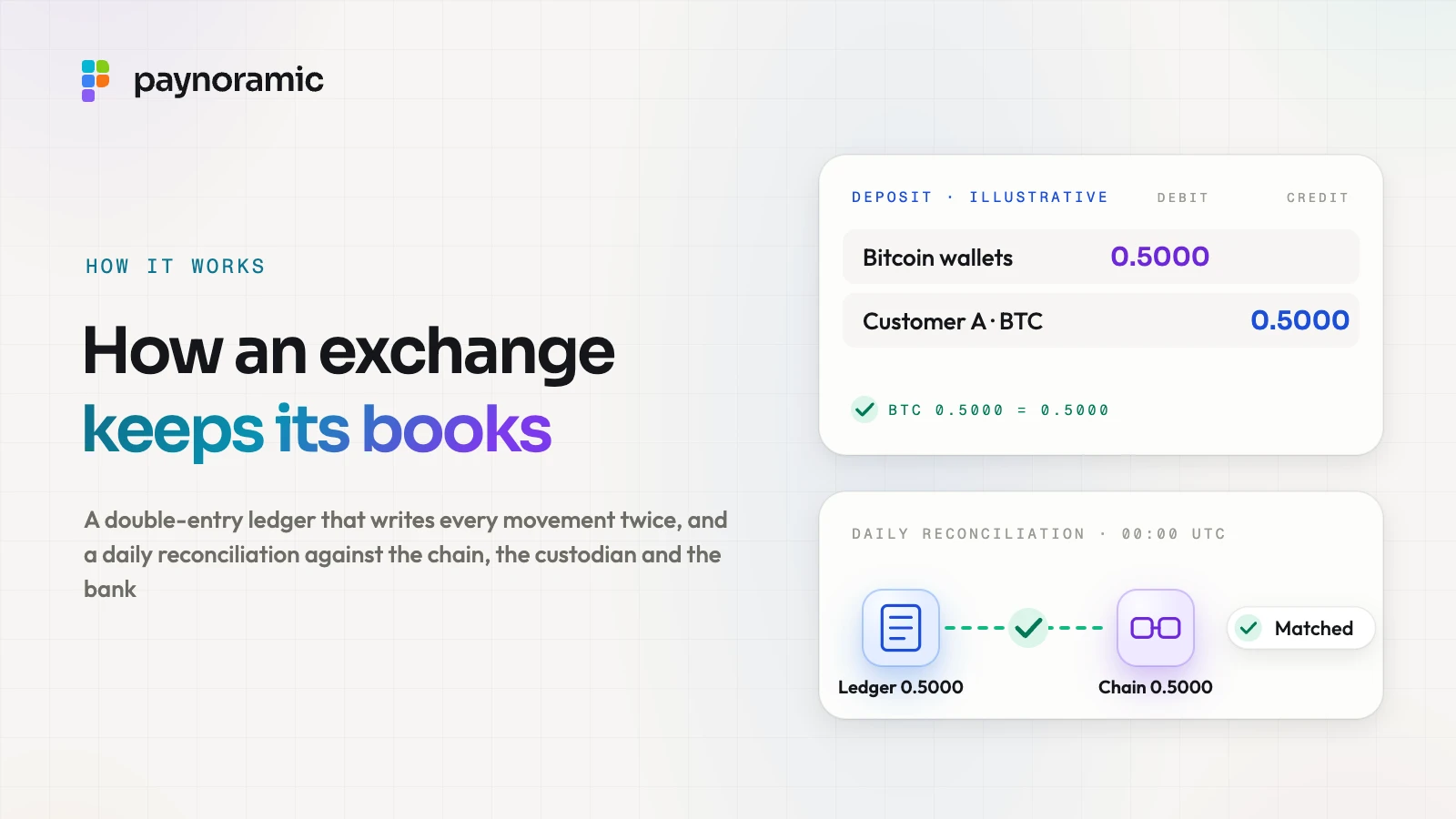
One side records the coins the exchange now holds; the other records that it owes them to the customer. The entry balances, so the ledger still matches the wallets, which is what the daily reconciliation checks. The network fee was paid by the sender on top, so the amount credited is the amount that arrived.
Later, the exchange usually sweeps deposits from the many customer addresses into its main wallets. That is an internal transfer: the coins move on chain, no customer's balance changes, and the network fee of the sweep is the exchange's own cost. Where those main wallets sit is set out in hot wallets, cold wallets and custodians. In Marengo, a double-entry ledger records every fill, fee and transfer, and a reconciliation checks every account.
Screening an incoming deposit
A licensed exchange does not only ask whether a deposit arrived; it also asks where it came from. Wallet screening checks the addresses the coins came from against sanctions lists and known risks, such as stolen funds, scams or mixers, using blockchain analytics that trace a payment back through earlier transactions.
The result decides what happens next. A clear deposit is credited as usual; a risky one can be credited but frozen, or held before crediting, while compliance staff review it. Transaction monitoring then watches the account's activity over time, and where the deposit comes from another regulated provider, information about the sender travels with it under the Travel Rule, as set out in KYC, AML and the Travel Rule.
Screening belongs to the controls an operator adds for its licence. For the client's licence, Paynoramic adds sanctions and wallet screening, transaction monitoring and Travel Rule messaging to the exchange it builds.
Deposits sent on the wrong network
A deposit sent on the wrong network lands at an address the exchange is not watching for that payment. Nobody has taken the coins, but the exchange's systems never see them, so they are not credited.
Whether they can be recovered depends on how the address was made:
Networks that share an address format. Ethereum and the networks that run its software use the same
0xaddresses, and an ordinary address controlled by one key is the same address on all of them. The exchange holds that key, so it can in principle move the coins, but it is a manual operation, and many exchanges offer it only for certain networks, if at all.Smart contract addresses. If the deposit address is a contract, the same address on another network may be empty, or someone else's, and the coins may be out of reach.
Tokens the exchange does not list. A token sent to a valid address on the right network is still ignored if its contract is not listed, and needs the same manual handling.
The best fix is the deposit screen itself: one network chosen by the customer before the address appears, the network named in full beside the address and its QR code, and a warning about what not to send to it.
Tags and memos on networks with a shared address
Some networks make an address per customer impractical. On the XRP Ledger, "to have an account, an address must hold a minimum amount of XRP", a reserve that protects the ledger from growing too large. An exchange with an address per customer would lock up a reserve for each one.
So the exchange uses one shared address and gives each customer a number, which the payment carries. On the XRP Ledger it is a destination tag, a 32-bit unsigned integer that tells the exchange which customer to credit; other networks call the same idea a memo.
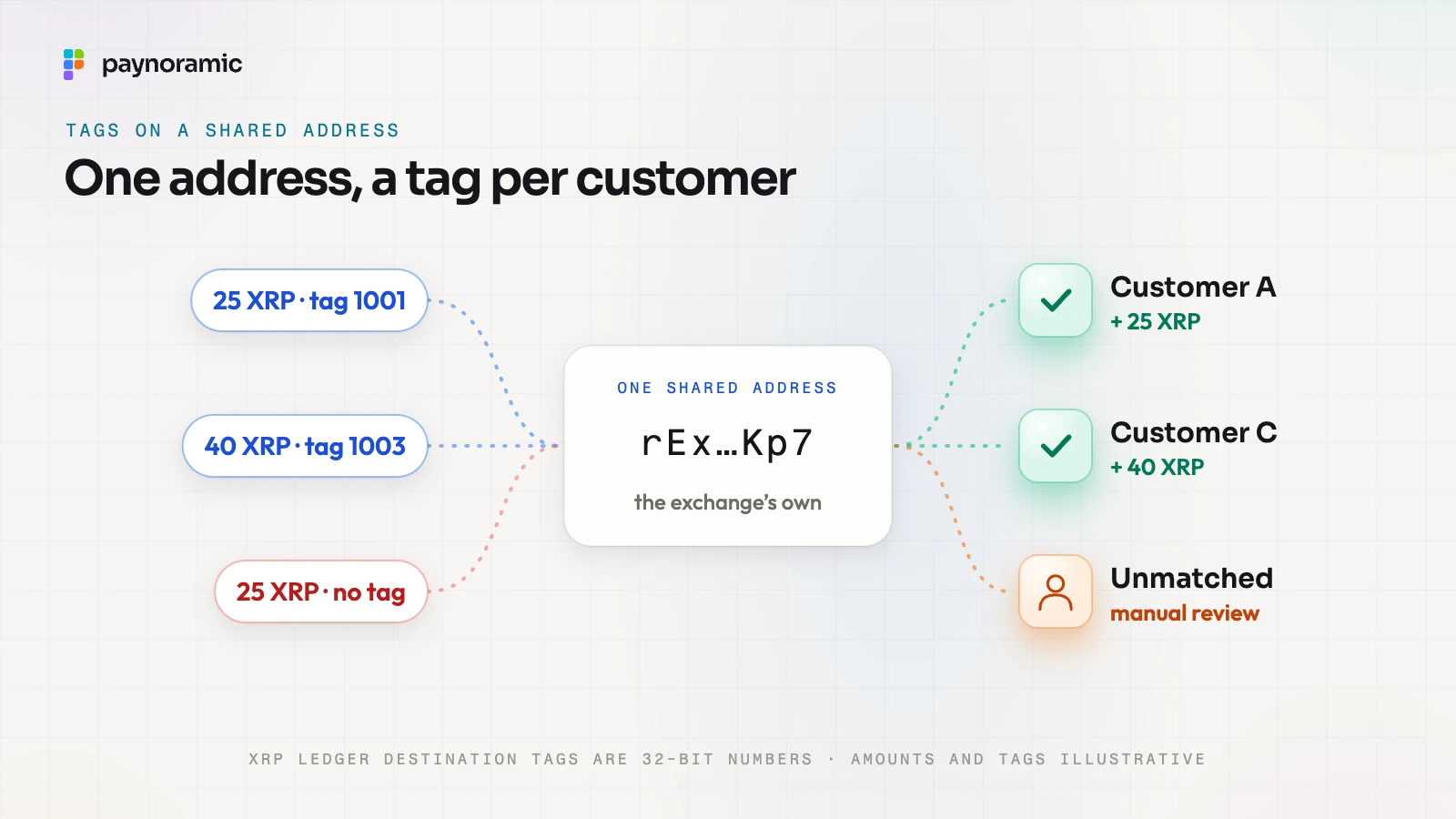
The tag replaces the per-customer address, so forgetting it breaks the matching. The coins reach the exchange, but nothing says whose they are, and the deposit waits in a queue until staff match it from the customer's proof, such as the transaction hash. The XRP Ledger offers a guard: an account can enable RequireDest, and the ledger then rejects payments without a tag instead of accepting them.
FAQ
Why does a deposit show as pending?
The exchange has seen the payment and is waiting for its confirmations. The count it shows rises with each new block, and the deposit is credited when the count reaches the exchange's number for that network.
Can an exchange credit a deposit before it is final?
Some do, for trading only. The deposit becomes tradable after a few confirmations, and the amount cannot be withdrawn until more have arrived, so a reversed deposit cannot leave the exchange.
Does the network fee reduce the amount credited?
No. The sender pays the network fee on top of the amount sent, and the exchange credits what arrived. A deposit fee charged by the exchange itself would be a separate entry in the ledger.
What happens if I forget the memo or tag?
The coins arrive at the exchange's shared address but cannot be matched to an account. Most exchanges can match them by hand from the transaction hash, which takes time.
See a deposit for yourself
A deposit is easiest to follow on a real screen, from the address to the balance. Open Marengo at marengo.paynoramic.com to see where deposits start, or how a double-entry ledger records every transfer, or read what is handed over on the white-label crypto exchange page.