What a crypto exchange licence costs: fees and capital by regulator
The application fee, the yearly fee and the capital a crypto exchange needs under MiCA, the FCA, VARA, ADGM and the DFSA, as each regulator publishes them, and when each falls due.
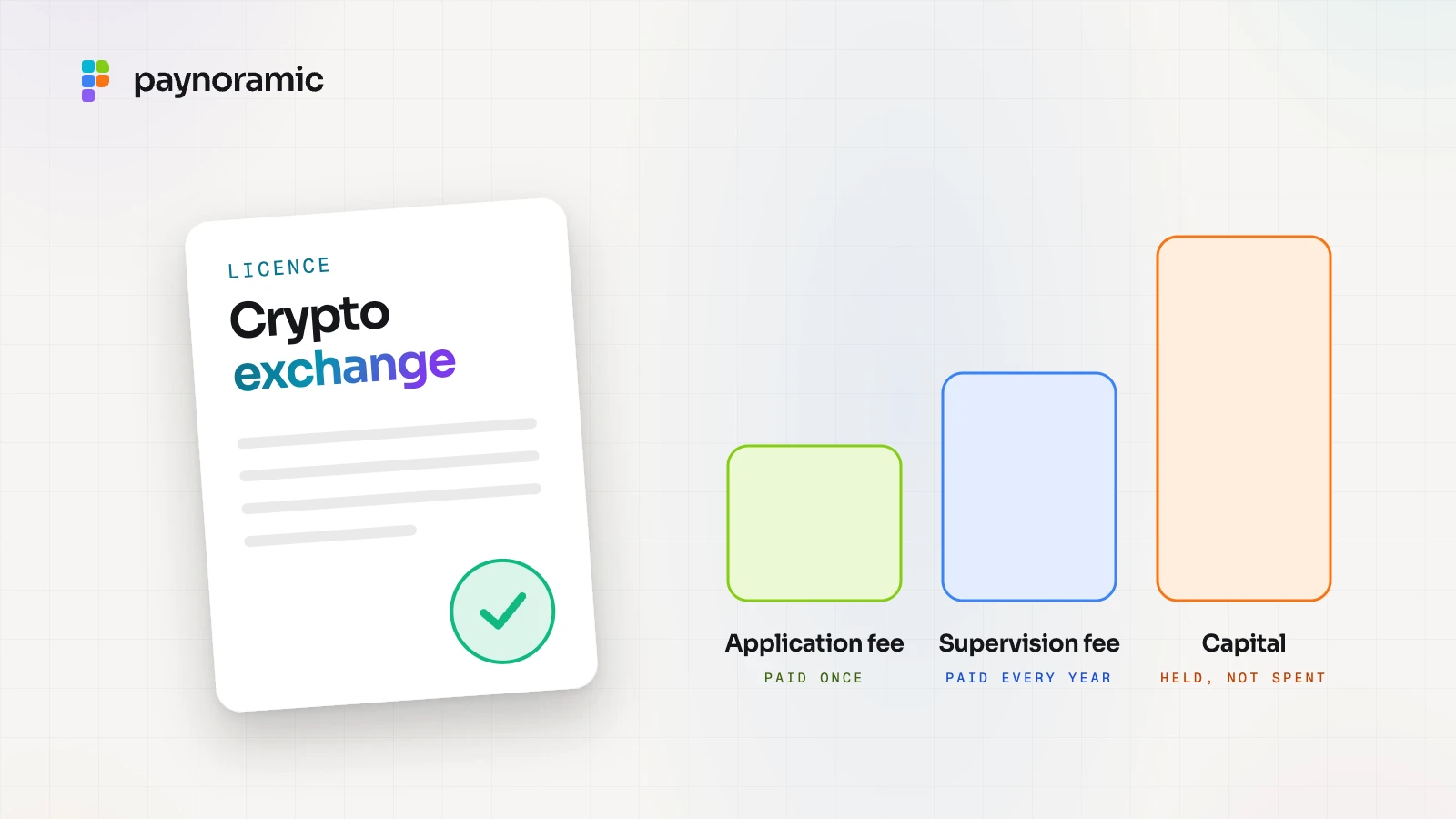
A crypto exchange licence costs three different kinds of money: a fee to apply, a fee every year once you are licensed, and capital that you hold for as long as you keep the licence. The capital is usually the largest. For a trading platform, the regulators' own figures run from €150,000 of capital in the EU to AED 1,500,000 in Dubai, with application fees from £28,150 in the UK to $150,000 in the Dubai International Financial Centre (DIFC).
This guide is general information, not legal advice: the details depend on your services and your market, so confirm them with a lawyer and the regulator before you apply. Every figure below was read on the regulator's own rulebook on 13 October 2026, and is given in the currency it is published in.
Three kinds of money
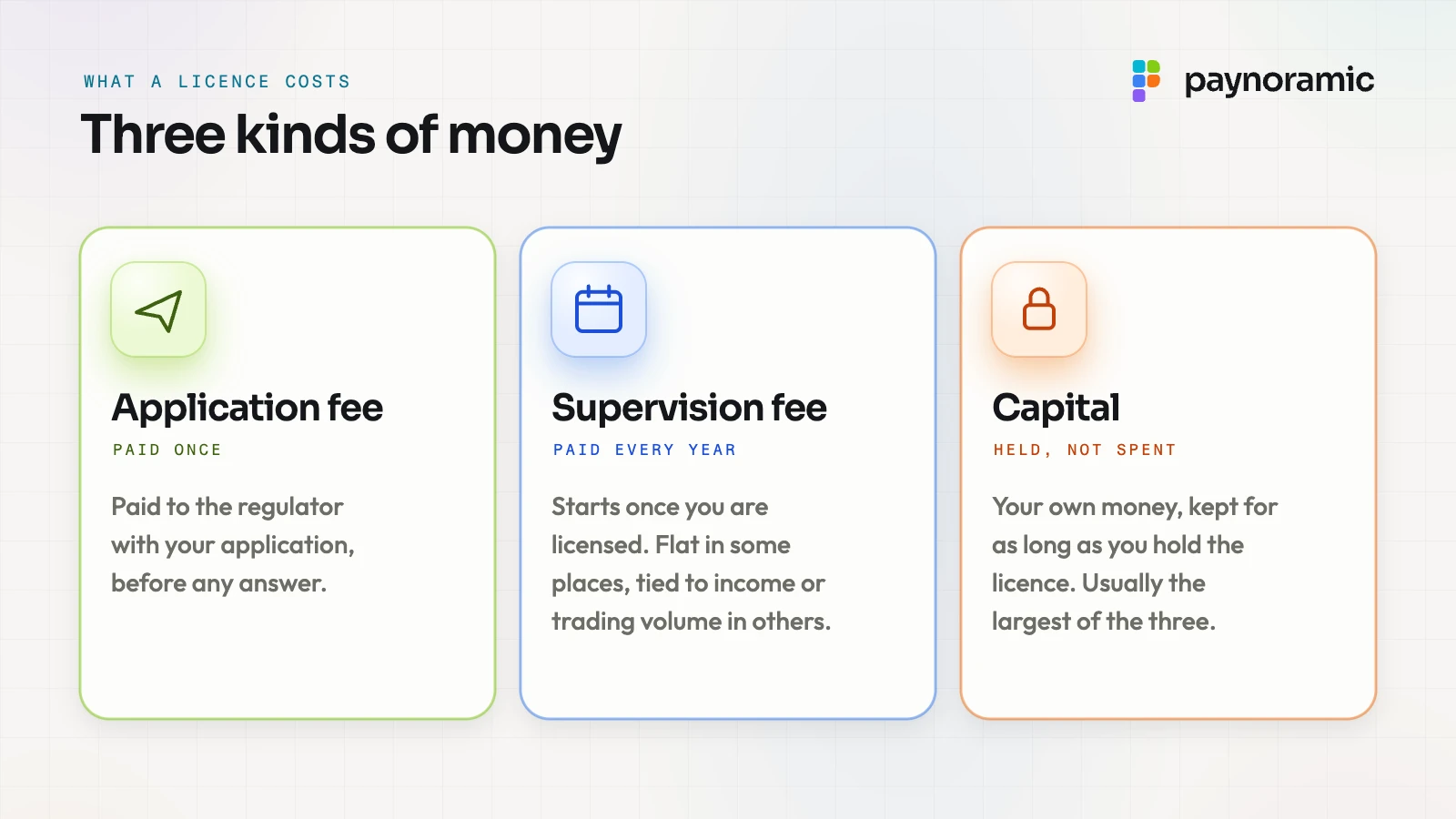
Founders usually ask for one number. There are three, and they behave differently in a budget.
The application fee is paid once, to the regulator, with the application. You pay it before you have an answer.
The supervision fee is paid every year from the day you are licensed. In some places it is a flat amount, in others it follows your income or your trading volume.
The capital is not a cost in the accounting sense. It is your own money, set aside and proven to the regulator, and it stays there. It is also the number that grows with the business, because most regulators tie it to your running costs.
What each regulator asks
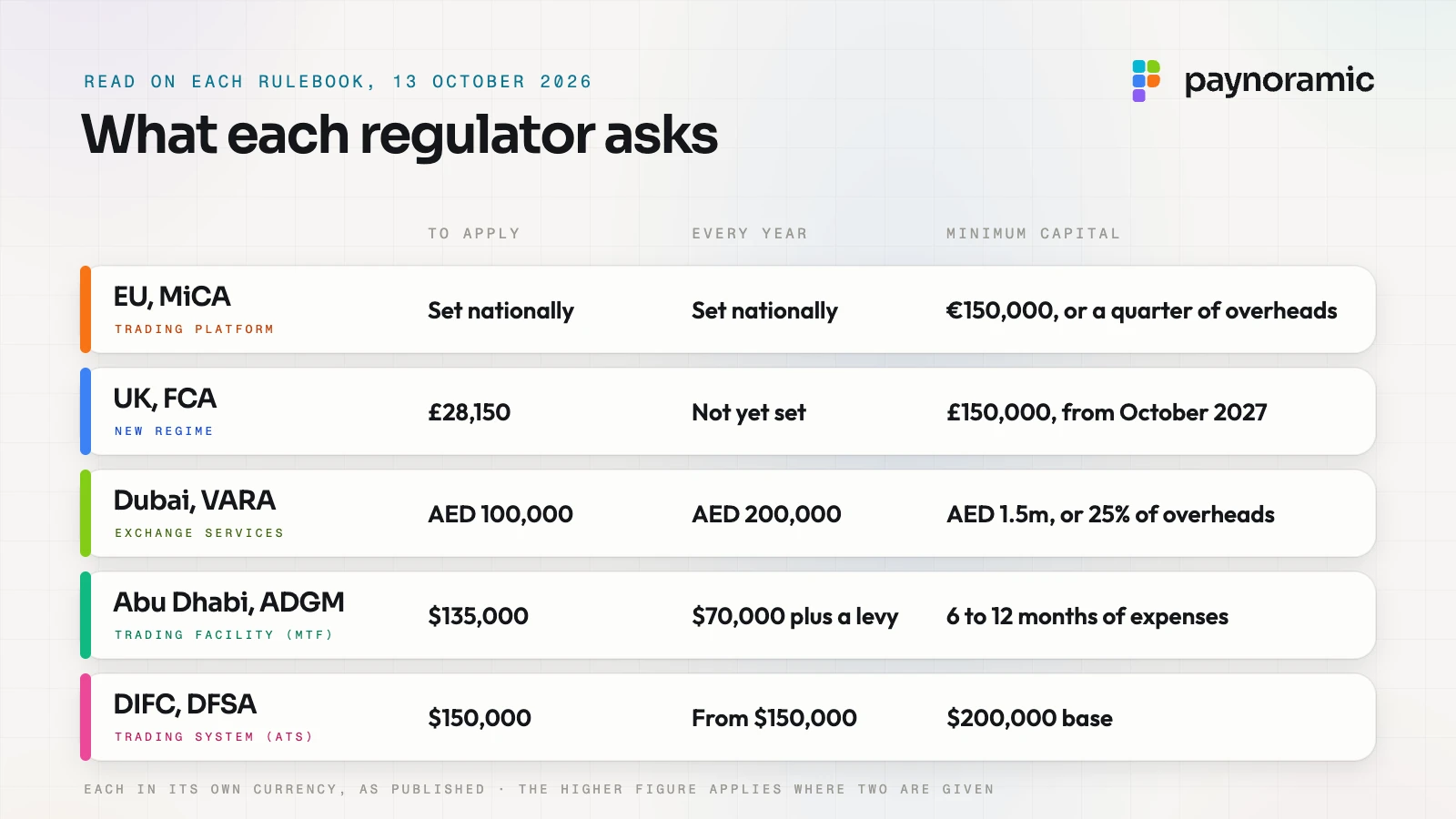
The table gives the figures for an exchange that runs its own order book, which every regulator treats as the most demanding activity.
Regulator | To apply | Every year | Minimum capital |
|---|---|---|---|
EU, MiCA (trading platform) | Set by each country | Set by each country | The higher of €150,000 or a quarter of fixed overheads |
UK, FCA (new regime, trading platform) | £28,150 | Not yet set | The highest of £150,000, a quarter of relevant expenditure, or a risk-based amount, from 25 October 2027 |
Dubai, VARA (Exchange Services) | AED 100,000 | AED 200,000 | The higher of AED 1,500,000 or 25% of fixed annual overheads |
Abu Dhabi, ADGM (trading facility) | $135,000 | $70,000, plus a levy on trading | Six months of operating expenses, plus up to six more |
DIFC, DFSA (trading system) | $150,000 | From $150,000, by trading volume | The highest of $200,000 or amounts based on spending and activity |
The EU: MiCA sets the capital, each country sets the fees
The Markets in Crypto-Assets Regulation (MiCA) puts crypto-asset service providers in three classes. Operating a trading platform is in the highest, with a permanent minimum of €150,000. Exchanging crypto for money without an order book, and custody, are in the middle class at €125,000 (Article 67 and Annex IV). If a quarter of last year's fixed overheads is more than the class minimum, that figure applies, and a new firm uses the overheads it projects for its first twelve months. The amount can be held as own funds or covered by an insurance policy or a comparable guarantee.
MiCA sets no fee for the authorisation. Each national authority charges its own, so the country you establish in decides it. Our MiCA checklist for a crypto exchange covers the rest of the file.
The UK: one regime ending, another starting
Today a crypto exchange registers with the Financial Conduct Authority (FCA) under the Money Laundering Regulations. The application fee is £11,260. The yearly fee for 2026/27 is at least £2,251, plus £6.01 for every £1,000 of income above £100,000. The FCA's pages for this registration name no capital figure.
That regime is being replaced. Authorisation under the Financial Services and Markets Act starts on 25 October 2027, and the FCA's application window opened on 30 September 2026 and closes on 28 February 2027. The fee to apply is already in force: £28,150 for operating a trading platform, £11,260 for dealing as principal or safeguarding, and £2,820 for arranging deals. The FCA's final capital rules, published on 30 June 2026, apply from the same October date: £150,000 for a trading platform, and £750,000 for a firm that deals as principal, or more where a quarter of its relevant expenditure or its risk-based requirement is higher. Our guide to FCA cryptoasset registration walks through the application.
Dubai: VARA
For Exchange Services, Dubai's Virtual Assets Regulatory Authority (VARA) charges AED 100,000 to apply and AED 200,000 a year in supervision, and each further activity adds half of the lower application fee (Schedule 2 of its Regulations). Paid-up capital is the higher of AED 1,500,000 or 25% of fixed annual overheads. It falls to the higher of AED 800,000 or 15% when the exchange uses a VARA-licensed custodian, or an arrangement VARA approves during licensing.
VARA also says where the capital sits: in a trust account at a UAE bank with VARA as beneficiary, or as a surety bond. On top of it come net liquid assets of at least 1.2 times monthly operating expenses, and reserve assets equal to everything you owe clients, one for one in the same asset. The VARA licence guide has the rest.
Abu Dhabi: ADGM
In Abu Dhabi Global Market (ADGM), the Financial Services Regulatory Authority charges a virtual asset fee on top of the fee for the activity itself. For a firm operating a multilateral trading facility, the virtual asset fee is $125,000 to apply and $60,000 a year, and the trading facility's own fee is $10,000 and $10,000. That makes $135,000 and $70,000. A trading levy follows, from 0.0015% of daily trading value down to 0.0006% as volume grows, paid monthly. A firm with no trading facility pays far less: a virtual asset fee of $20,000 and $15,000 for all its virtual asset activities together, on top of each activity's own fee.
There is no fixed capital floor for the trading facility. The authority's guidance asks for six months of operating expenses in fiat, plus a buffer of up to six more. Custody of virtual assets needs the higher of $250,000 or six months of audited expenditure.
DIFC: the DFSA
Inside DIFC, the Dubai Financial Services Authority (DFSA) licenses a crypto trading venue as an alternative trading system. The application fee is $150,000, with $20,000 more to serve retail clients. The yearly fee starts at $150,000 and rises in bands with average daily trading volume, to $800,000 above $200 million a day, plus a small amount based on your expenditure. Base capital for this category is $200,000, and the requirement is the highest of that base or figures based on spending and activity, where they apply. If you are weighing the three UAE regulators, start with VARA, ADGM or DIFC.
How the capital is worked out
The capital rules look different in every rulebook, but there are only three ways of writing them.
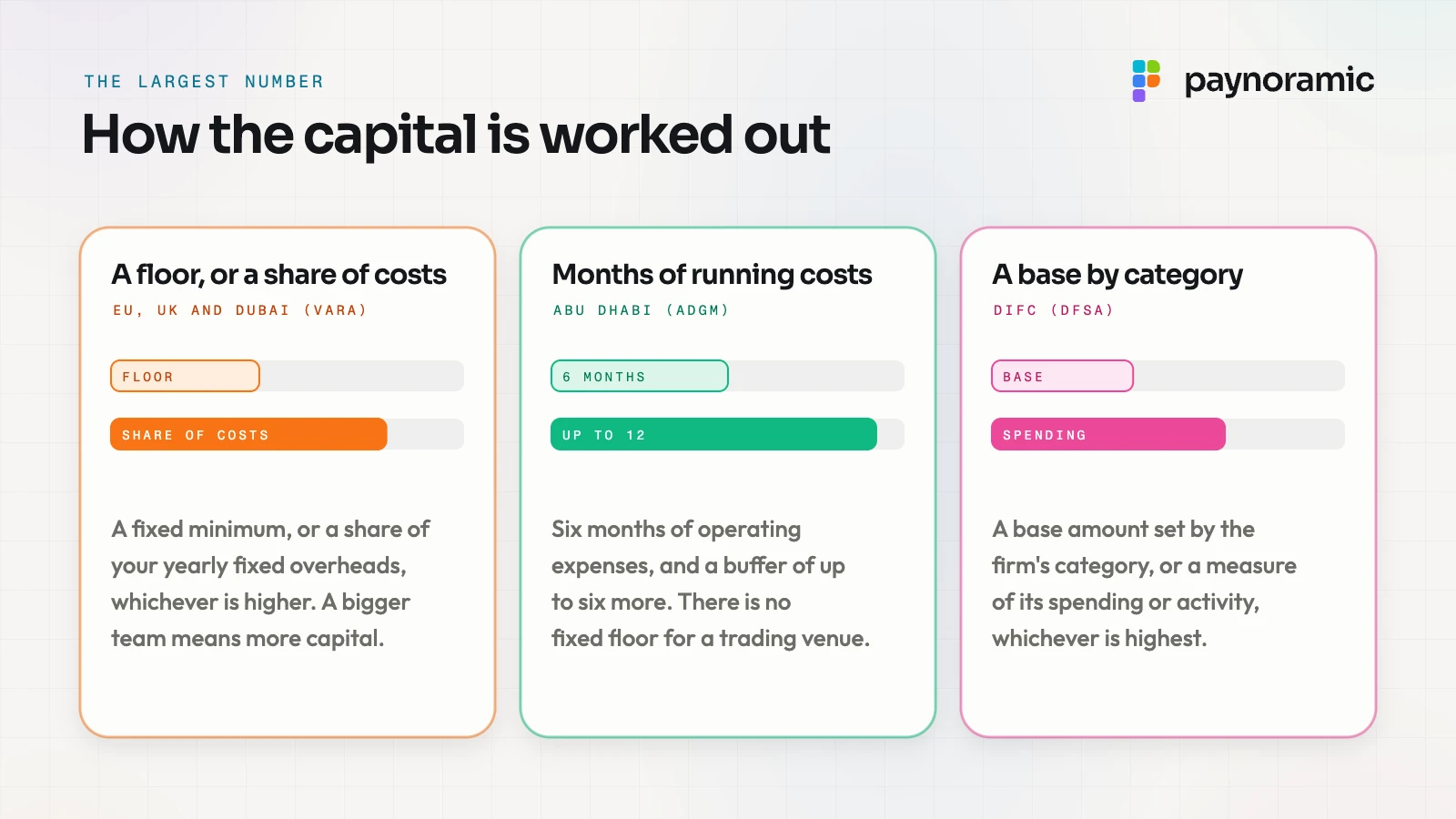
A floor, or a share of your costs. The EU, the UK and VARA name a minimum and a share of your fixed overheads, and take the higher. For a small team the floor applies. Once yearly overheads pass four times the floor in the EU or the UK, or six million dirhams in Dubai, the share takes over.
Months of running costs. ADGM names no floor for a trading facility and asks for six to twelve months of expenses. The plan you submit sets your capital.
A base by category. The DFSA gives each category of firm a base, then tests it against your spending and activity.
In all three, the lesson for a budget is the same: every hire and every contract in your plan raises the capital you must show, long before it raises your income.
When each cost falls due
A licence is not paid for in one day. The names of the stages differ by regulator, and the order does not.
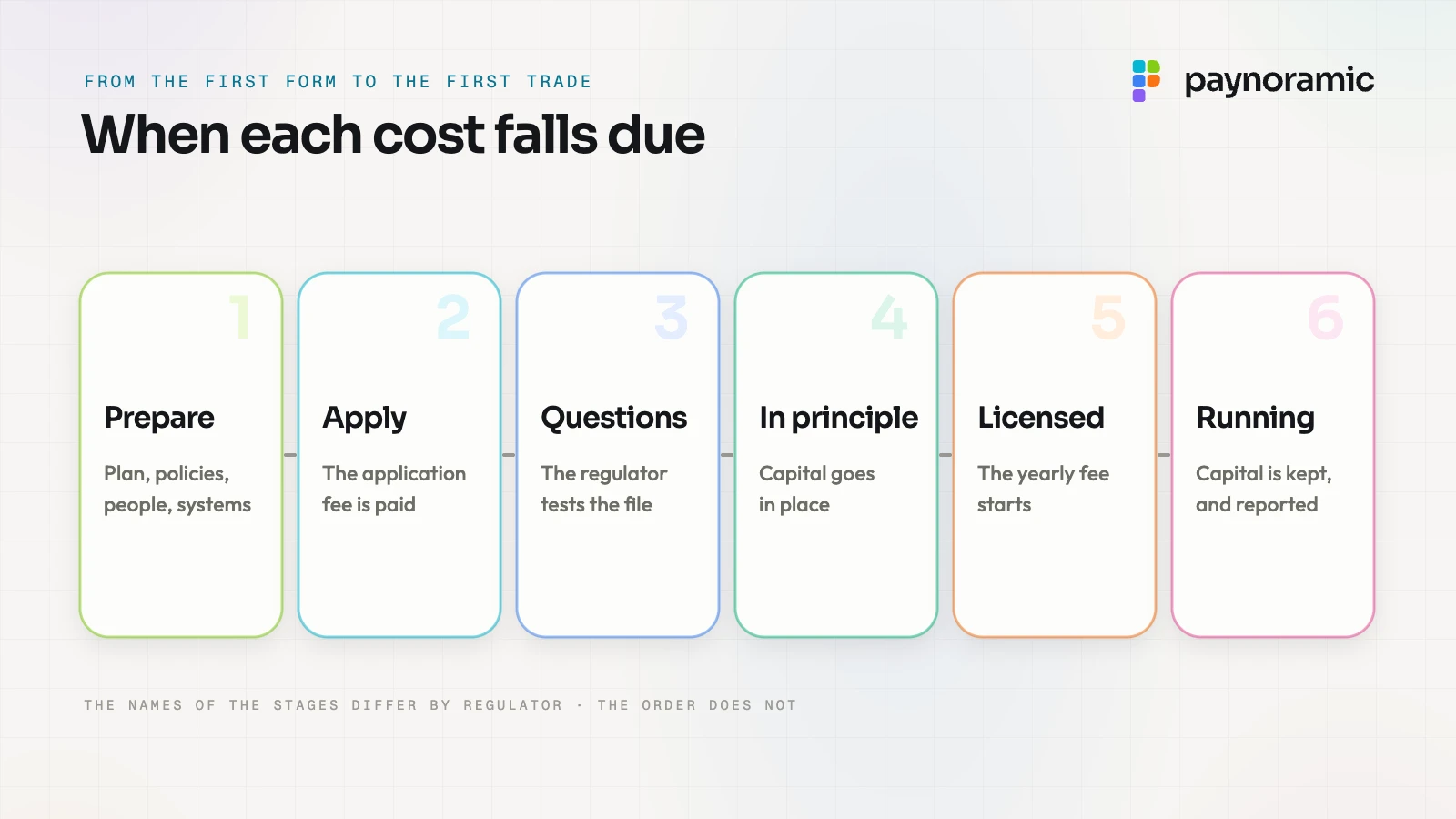
Prepare. The business plan, the policies, the people who will hold the regulated roles and the systems are described before anything is filed. This is where most of the time goes, and it costs advice and salaries, not fees.
Apply. The application fee is paid with the file. VARA takes it in two stages, with the first typically half of the application fee.
Answer questions. The regulator tests the file: who owns the firm, how client assets are kept apart, how the systems hold up.
Approval, often in principle first. Conditions are set, and the capital has to be in place and proven in the form the regulator names. Under MiCA, proof of it is part of the application itself.
Licensed. The supervision fee starts, and so do the returns.
Running. The capital is recalculated as your costs change, and reported.
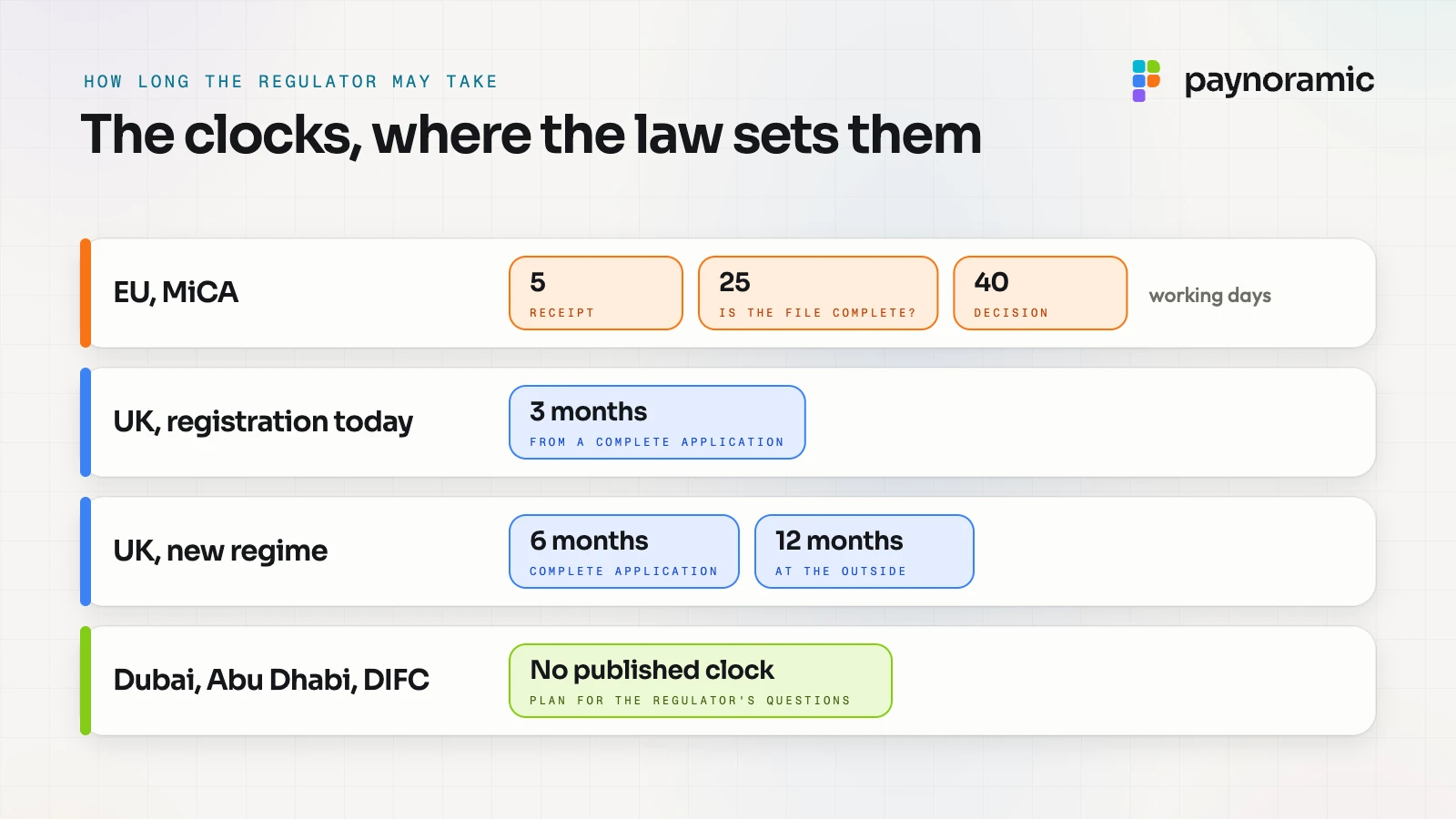
Only some regulators publish how long they take. Under MiCA an authority has 25 working days to say whether the file is complete, then 40 working days to decide. The FCA has three months for today's registration, and six months from a complete application under the new regime, twelve at the outside. VARA, ADGM and the DFSA publish no duration, so plan around the questions, not a date.
The costs around the licence
The three numbers above are the ones a regulator publishes. A real budget has more lines, and none of them has an official price.
People in regulated roles. VARA, for one, asks for two Responsible Individuals, a compliance officer, a money laundering reporting officer and a head of information security, with the first three living in the UAE or holding its passport.
An office. VARA requires a physical presence in Dubai, and ADGM expects a firm's mind and management inside the zone.
Insurance and audit. VARA names three kinds of cover without setting an amount, and asks for an independent audit of client reserves at least every six months.
Legal advice. The file is long, and the questions come back more than once.
Common mistakes
Budgeting the fee and forgetting the capital. In Dubai the capital is fifteen times the application fee.
Treating the capital as fixed. It follows your overheads, so the plan you submit decides it.
Choosing a regulator by the application fee. The yearly fee and the capital, over three years, tell a different story.
Applying for every activity at once. Each activity adds fees, and custody in particular brings its own capital. Using a licensed custodian lowers VARA's capital by almost half.
Missing a window. The FCA's application window closes on 28 February 2027.
What this means for your platform
Fees are fixed by the regulator. The two things you control are how fast you can show a working, compliant platform, and how large the overheads in your plan are. Both depend on what you build and what you assemble.
A crypto exchange assembled from our module library arrives with the parts the regulator's questions are about:
The ledger is a double-entry book of every balance, reconciled daily against external statements, with audit exports. That is the record behind client asset and reserve rules.
Custody and wallets gives each customer their own deposit addresses, with withdrawal approvals and proof of reserves reporting, on custody providers such as Fireblocks or BitGo, or on your own keys.
The matching engine keeps a full audit trail of orders and fills, with circuit breakers and trading halts.
KYC and AML and compliance reporting cover identity checks, screening, transaction monitoring, the Travel Rule and the regulatory reports.
The backoffice gives your compliance team one console, with roles, two-person approval and a log of every action.
Software that already exists does not need a team to build it, which keeps the overheads in your plan, and so your capital, lower. You own the source code from the day of handover. Tell us which regulator you are applying to, and we will show you the platform against its rulebook.